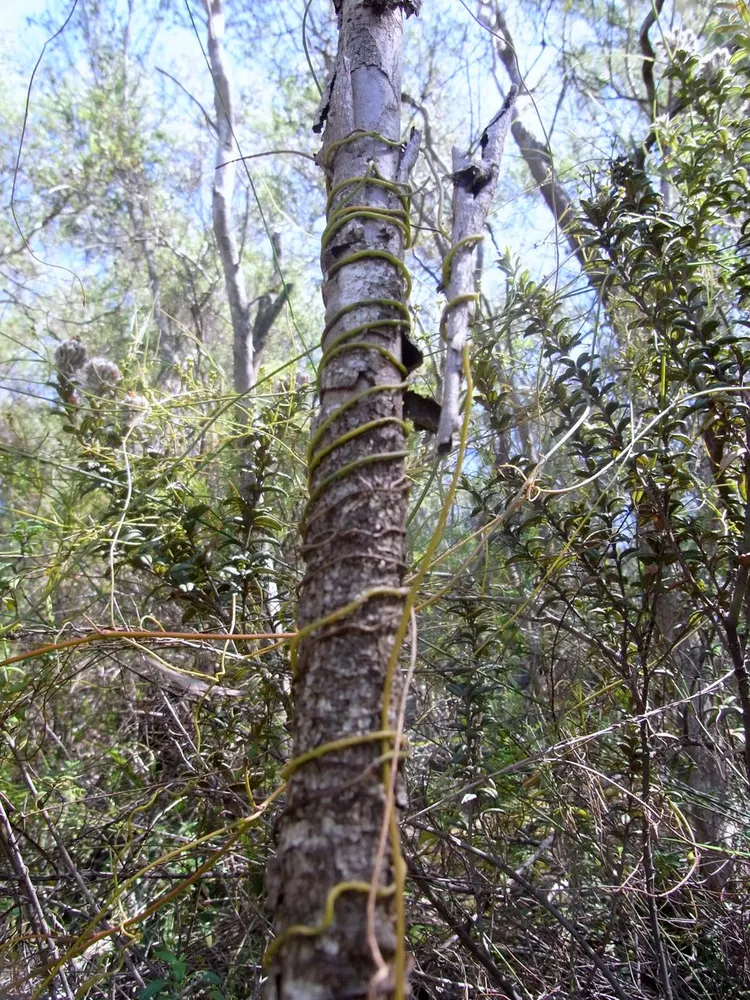
Photo: Poyt448 Peter Woodard, Public domain (via Wikimedia Commons)
Devil's Twine
Cassytha pubescens
Also known as Downy Dodder-laurel, Dodder Laurel, Native Dodder
Key benefits
✦Traditional uses
✦Devil's twine carries its warning right in the name. Early settlers and bushwalkers watched this leafless, wiry vine throw itself over gorse, heath shrubs, and wattles, and likened its slow, strangling embrace to something almost sinister. Unlike most plants in this atlas, it was never gathered for the kitchen or the medicine chest, its story belongs to the paddock and the open heath rather than the apothecary shelf. Australian ecologists have since turned its parasitic talent to purpose, studying Cassytha pubescens as a natural check on invasive European gorse, letting one tenacious vine do work that machines and chemicals struggle to match.
How to grow & use it
✦The full apothecary for Devil's Twine
Traditional remedies and step-by-step preparations, a complete growing guide, and how to harvest, dry, and store it, all unlocked with HerbLens Unlimited.
- ✦Remedies & preparations
- ✦ Growing guide
- ✦Harvest & storage
From under $6 a month. Free plant identifications always included.
“For the quiet drama of the heath, where one patient green thread slowly outwaits its neighbor.”
Though it looks every bit like the unrelated dodder vines (Cuscuta) it seems to mimic, leafless orange-green stem for leafless orange-green stem, devil's twine actually belongs to the laurel family, Lauraceae, the very same family as cinnamon and bay leaf, making it one of the strangest outliers on that fragrant family tree.
Devil's twine has no established history of internal or medicinal use, and no traditional dosing or preparation for human consumption has been documented, so it should not be ingested or brewed. As a parasitic vine, its real hazard is to plants rather than people, it twines over shrubs like gorse and wattle and taps into them with root-like haustoria, gradually weakening or killing the host by drawing off its water and nutrients. It can also be mistaken for the unrelated dodder vines (Cuscuta species), so careful identification matters if you encounter it in the field. Speak with a qualified botanist, herbalist, or healthcare professional before using any wild or unfamiliar plant.