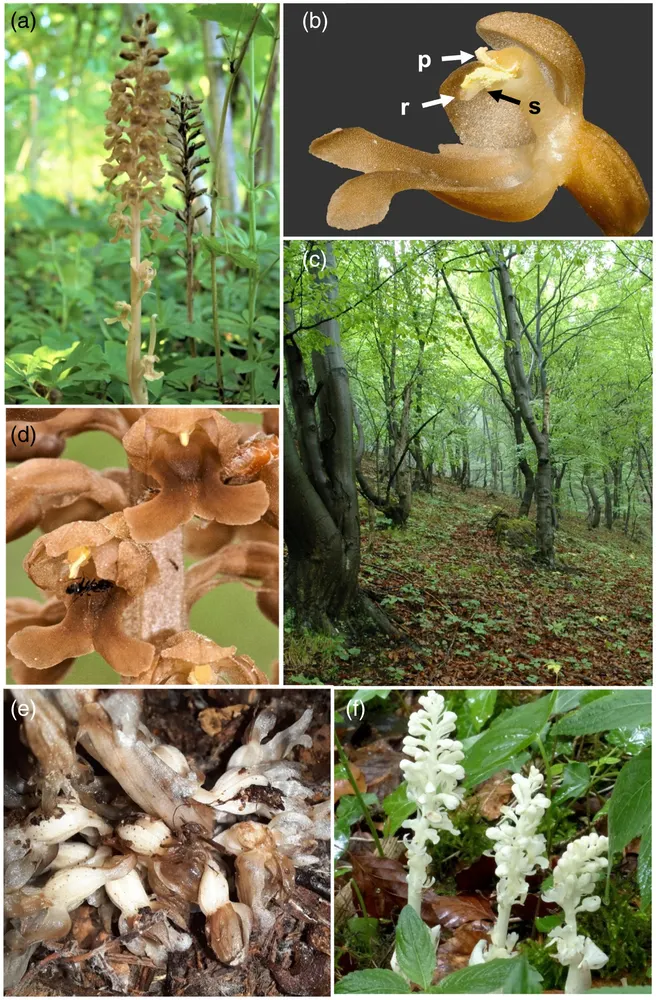
Photo: Jana Jersáková, Julita Minasiewicz & Marc-André Selosse, CC BY 4.0 (via Wikimedia Commons)
Bird's Nest Orchid
Neottia nidus-avis
Also known as Bird's Nest Orchid, Neottia, Nidus avis
Key benefits
✦Traditional uses
✦Unlike most plants in this atlas, the bird's nest orchid never earned a place in the apothecary cabinet. It carries no real record of medicinal or culinary use, and none should be invented for it here. What it did earn, for centuries, was the fascination of naturalists, who found a leafless, chlorophyll-less spike pushing up through the dark forest floor and struggled to explain how something so pale could live without ever turning toward the sun. Its true tradition is one of wonder rather than remedy, a plant written about in old field notes and herbals more as a puzzle of nature than a cure.
How to grow & use it
✦The full apothecary for Bird's Nest Orchid
Traditional remedies and step-by-step preparations, a complete growing guide, and how to harvest, dry, and store it, all unlocked with HerbLens Unlimited.
- ✦Remedies & preparations
- ✦ Growing guide
- ✦Harvest & storage
From under $6 a month. Free plant identifications always included.
“For the hushed thrill of spotting a ghost-pale spike rising from the leaf litter of an old beech wood, and nothing more than that.”
The bird's nest orchid has no green in it at all, not in its leaves (it has none) and not in its stem. It survives entirely by plugging into mycorrhizal fungi threaded through the forest soil, fungi that are simultaneously feeding sugars to nearby trees, so the orchid is essentially living off borrowed tree sap by way of a fungal middleman. Its tangled mass of short, thick roots, said to resemble a matted bird's nest, is exactly where its scientific name and common name both come from.
This orchid has no history of food or medicinal use and should never be eaten. It depends on a living fungal network and is protected in many regions, so digging it up kills the plant and may be illegal; enjoy it only by sight.