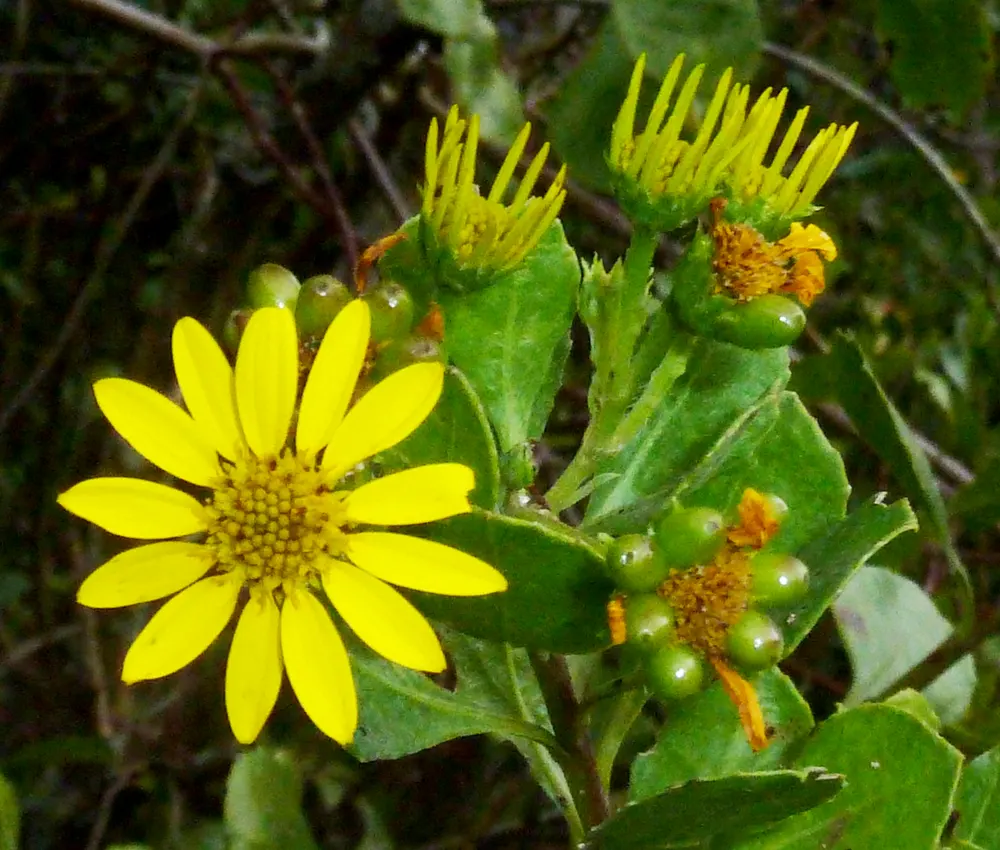
Photo: JMK, CC BY-SA 3.0 (via Wikimedia Commons)
Bietou (Bush Tick-Berry)
Osteospermum moniliferum
Also known as Bush Tick-berry, Bitou Bush, Boneseed, Weskusbietou, Tick-berry
Key benefits
✦Traditional uses
✦Bietou is one of the great pioneers of the South African coast, often the first shrub to green a dune or a stretch of burned fynbos after fire has passed through. Coastal communities have long valued it less as a medicine chest than as a landscape ally, planted and left to spread for the way its tangled roots hold sand in place against wind and tide. Its sticky, dark seeds cling to the fur of passing animals like little ticks, which is how the shrub earned its common name and how it has quietly hitched rides along the coastline for generations. Unlike many of its Asteraceae cousins, it was never widely adopted as a healing herb, and its reputation rests instead on its toughness and its generosity to bees and birds.
How to grow & use it
✦The full apothecary for Bietou (Bush Tick-Berry)
Traditional remedies and step-by-step preparations, a complete growing guide, and how to harvest, dry, and store it, all unlocked with HerbLens Unlimited.
- ✦Remedies & preparations
- ✦ Growing guide
- ✦Harvest & storage
From under $6 a month. Free plant identifications always included.
- ✦Restios
- ✦Pelargoniums
- ✦Coastal buchu
- ✦Arctotheca (dune spinach) for dune stabilization
- ✦Osteospermum ecklonis for a garden daisy with similar habit
“For the first green on a burned dune, and gold that holds the coastline together.”
The species name moniliferum comes from Latin for necklace-bearing, a nod to the way its small fruits cluster along the stem like beads strung on a cord.
Not used as an internal medicine; its pollen and sap can irritate skin or trigger reactions in people sensitive to ragweed or other daisy family plants. It is considered invasive in parts of Australia and New Zealand, where planting may be restricted.