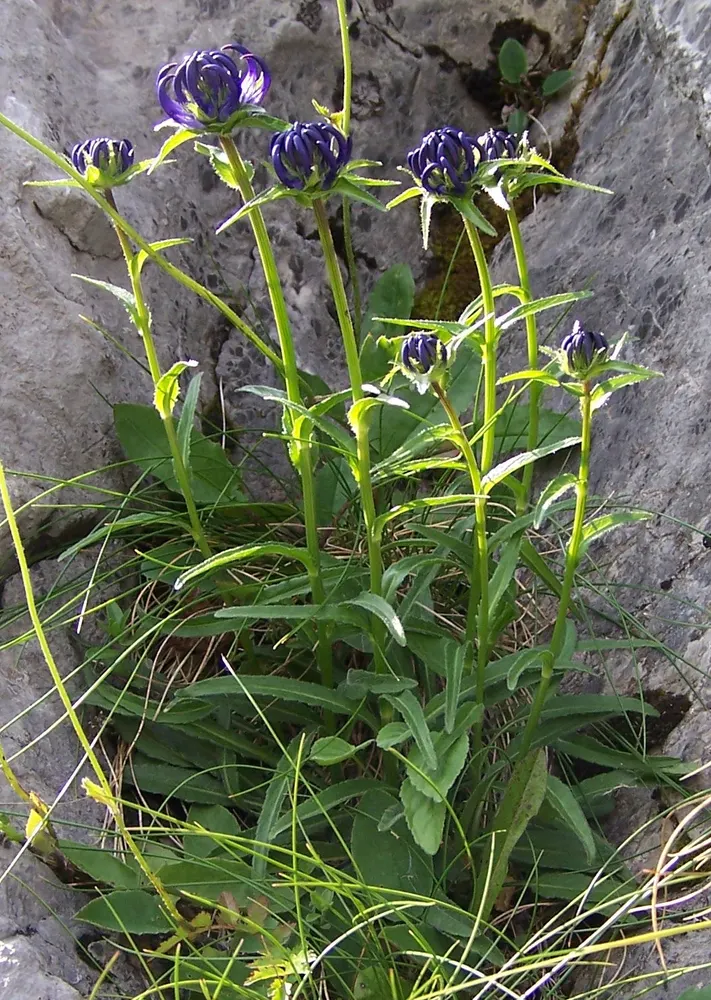
Photo: Jerzy Opioła, CC BY-SA 3.0 (via Wikimedia Commons)
Round-headed Rampion
Phyteuma orbiculare
Also known as Pride of Sussex, Round-headed Phyteuma, Blue Devil (regional folk name)
Key benefits
✦Traditional uses
✦Round-headed rampion has never been a kitchen or apothecary staple the way its relatives were, but it has long been treasured simply for its presence on the chalk downs of southern England and the limestone meadows of continental Europe. Where it grows thickly, its tight, spiky-looking globes of violet-blue flowers were gathered into small summer posies, and its scarcity even made it a point of local pride. In parts of rural Europe, young leaves from the basal rosette were occasionally nibbled or added to spring salads in the same casual way people once sampled other wild Campanulaceae greens, though this was more foraging curiosity than established practice. It carries no meaningful history as a medicinal herb.
How to grow & use it
✦The full apothecary for Round-headed Rampion
Traditional remedies and step-by-step preparations, a complete growing guide, and how to harvest, dry, and store it, all unlocked with HerbLens Unlimited.
- ✦Remedies & preparations
- ✦ Growing guide
- ✦Harvest & storage
From under $6 a month. Free plant identifications always included.
- ✦Harebell (Campanula rotundifolia)
- ✦Small scabious (Scabiosa columbaria)
- ✦Wild thyme (Thymus polytrichus)
- ✦Harebell (Campanula rotundifolia)
- ✦Devil's-bit scabious (Succisa pratensis)
“You want a true patch of chalk downland summer, all violet-blue pincushions humming with bees.”
Round-headed rampion was voted the county flower of Sussex, England in a 2002 wildflower poll, earning it the local nickname 'Pride of Sussex.' It grows almost nowhere else in Britain outside the chalk downs of the south, which made it feel like a genuine local treasure worth protecting.
No toxicity, allergen, or drug-interaction concerns are documented for Phyteuma orbiculare, but it also has no real history as a medicinal or culinary herb, so there are no traditional doses or preparations to offer here. It is a scarce plant across much of its native chalk grassland range and populations can be slow to recover from picking, so admire and photograph wild stands rather than collecting from them, and grow it from responsibly sourced seed instead. As with any wild plant you are unfamiliar with, do not eat any part of it without positive identification by an experienced botanist, and speak with a qualified professional before using any plant medicinally.