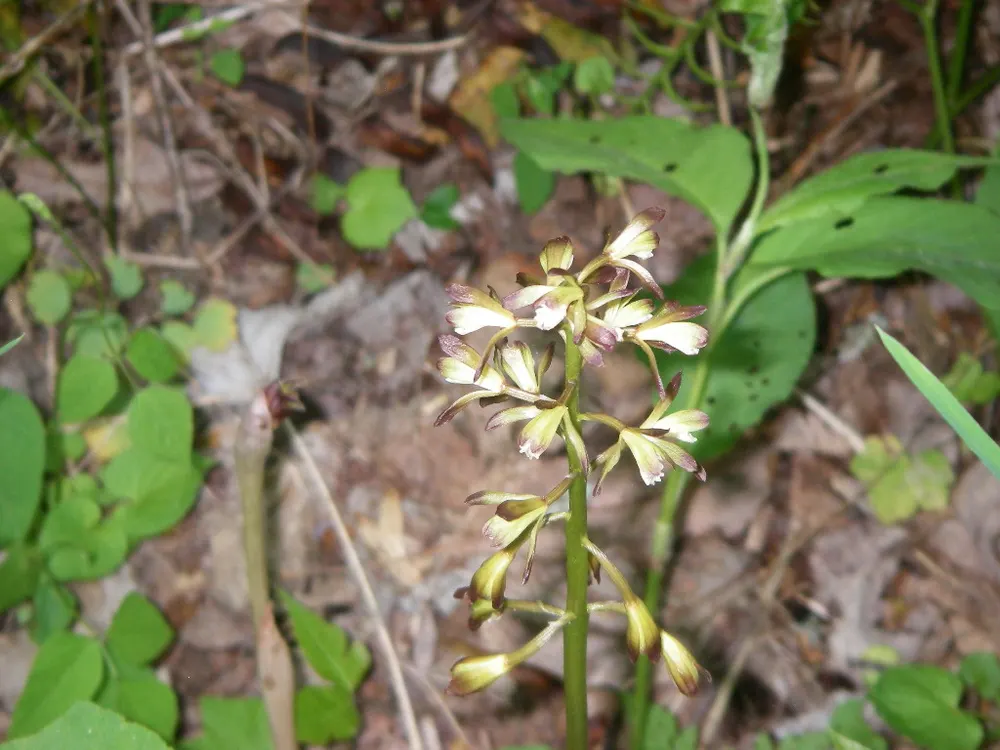
Photo: Halpaugh, CC BY-SA 3.0 (via Wikimedia Commons)
Putty Root
Aplectrum hyemale
Also known as Adam and Eve, Adam-and-Eve Root, Puttyroot Orchid
Key benefits
✦Traditional uses
✦Long before glue came in a bottle, early Appalachian and Midwestern households prized putty root for the sticky, mucilaginous sap inside its corm, which was pressed into service to mend cracked crockery and broken china, giving the plant its common name. Its underground growth habit, one older rounded corm attached by a short rhizome to a newer one, was seen as a pair standing together, and folk tradition in the Ozarks and Appalachians came to call the two joined corms Adam and Eve, carried together in a small bag as a charm meant to keep a couple bonded in love. The plant itself is a quiet oddity of the forest floor, sending up a single pleated, dark green leaf in autumn that stays green through the coldest months (hyemale means of winter), then withers away just as the leafless flower stalk rises in its place come spring. It has never been a kitchen or medicine-chest herb in the way many woodland plants are, its value was always practical and symbolic rather than curative.
How to grow & use it
✦The full apothecary for Putty Root
Traditional remedies and step-by-step preparations, a complete growing guide, and how to harvest, dry, and store it, all unlocked with HerbLens Unlimited.
- ✦Remedies & preparations
- ✦ Growing guide
- ✦Harvest & storage
From under $6 a month. Free plant identifications always included.
- ✦Solomon's seal
- ✦Jack-in-the-pulpit
- ✦Trillium
- ✦None traditionally recognized; putty root's known uses were practical (as a glue) and folkloric rather than herbal or medicinal
“For the quiet surprise of a single green leaf holding on through a snow-covered woodland floor, long after everything else has gone to sleep.”
The two corms that give this orchid its Adam and Eve nickname, one weathered and old, one plump and new, connected by a short underground stem, were carried together as a love charm in old Ozark and Appalachian folk magic, on the belief that keeping the pair together would keep a couple together too.
No reliable safety data exists for internal use, so it should not be taken by mouth. It's also an uncommon woodland orchid that rarely recovers once dug, so leave it undisturbed in the wild.