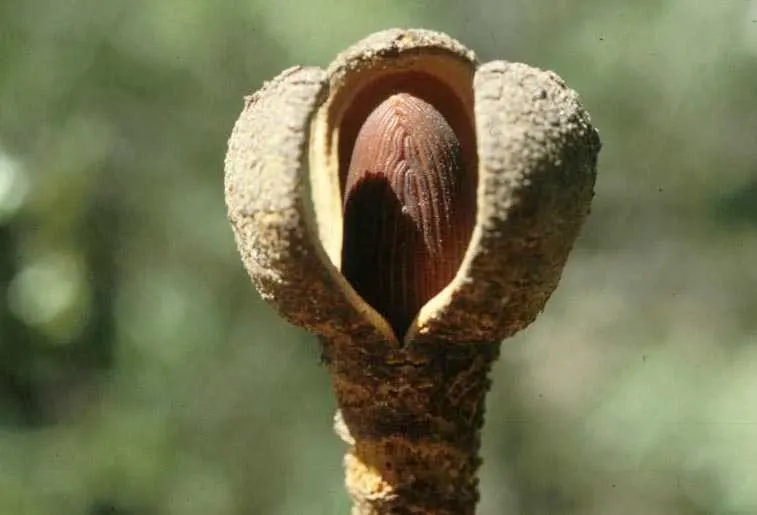
Photo: Lytton John Musselman, CC BY-SA 3.0 (via Wikimedia Commons)
Flor de Piedra (Stone Flower)
Prosopanche americana
Also known as Papa del Monte, Flor de la Tierra
Traditional uses
✦Prosopanche americana is one of the strangest plants a wanderer of the South American scrub could hope to stumble across, a flower with no stem, no leaves, and no green in it at all, pushing up through bare sand as if the earth itself had decided to bloom. It lives its whole life fused to the roots of Prosopis trees, the hardy mesquite-like algarrobos of the region, drawing everything it needs from its host rather than the sun. Because it surfaces so rarely and so briefly, it never became a settled part of any regional herbal tradition the way its African cousins in the same family did, and it is better known today to botanists and curious hikers than to healers. We have chosen to leave the traditional remedies for this entry empty rather than guess, in keeping with how little is reliably recorded about using it.
How to grow & use it
✦The full apothecary for Flor de Piedra (Stone Flower)
Traditional remedies and step-by-step preparations, a complete growing guide, and how to harvest, dry, and store it, all unlocked with HerbLens Unlimited.
- ✦Remedies & preparations
- ✦ Growing guide
- ✦Harvest & storage
From under $6 a month. Free plant identifications always included.
“For the rare, ground-level wonder of a flower with no leaves at all, blooming secretly at the roots of a desert tree.”
Plants in the family Hydnoraceae, including Prosopanche americana, are so reduced by their parasitic lifestyle that they have no roots, no stems, and no leaves in the ordinary sense. Nearly the entire organism lives as a fungus-like mass woven into the root of its host tree, and the only part anyone ever sees is the flower that briefly breaks the surface of the soil to bloom.
No food or medicinal use is documented for this parasitic wildflower, and it is best left undisturbed in the wild rather than harvested.