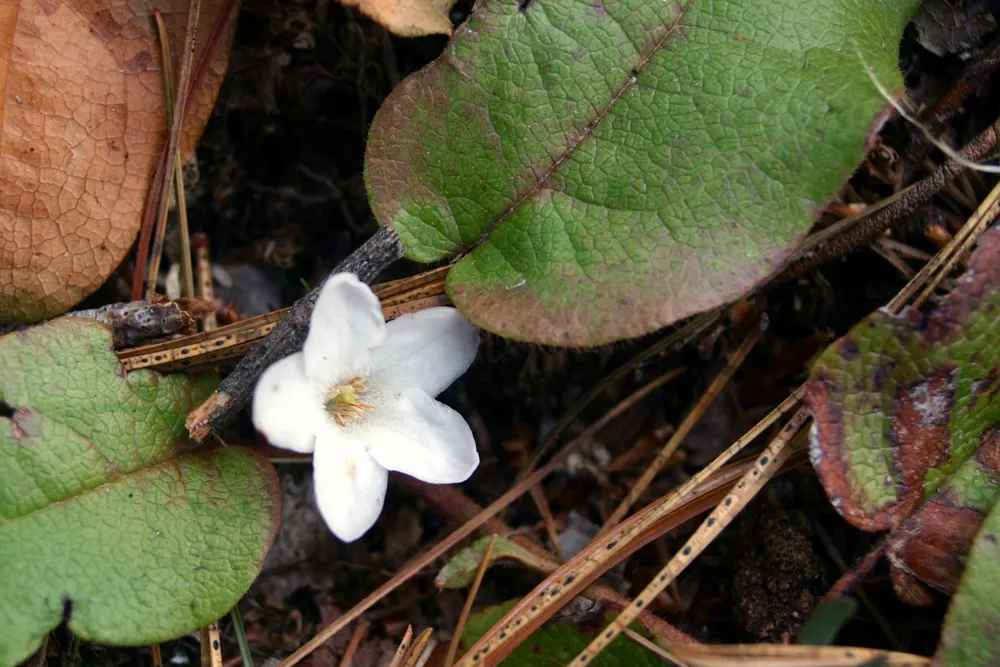
Photo: Justin Russell, Public domain (via Wikimedia Commons)
Trailing Arbutus
Epigaea repens
Also known as Mayflower, Ground Laurel, Gravel Plant, Shadflower
Key benefits
✦Traditional uses
✦Long before European settlement, trailing arbutus was gathered by several Northeastern nations, including the Algonquin and Iroquois, who valued a tea of its leathery leaves as a support for kidney and bladder complaints and as an aid during childbirth. English settlers later adopted the plant, and it earned the folk name mayflower from the legend that it was the first bloom the Plymouth colonists found after their brutal first winter, its sweet fragrance a welcome sign that spring had truly arrived. By the nineteenth century, Eclectic physicians were prescribing the dried leaf, much as they did the closely related uva ursi, as a mild urinary astringent. Today the plant is treasured more for its story and its perfume than for regular medicinal use, in part because it has grown scarce across much of its old range.
How to grow & use it
✦The full apothecary for Trailing Arbutus
Traditional remedies and step-by-step preparations, a complete growing guide, and how to harvest, dry, and store it, all unlocked with HerbLens Unlimited.
- ✦Remedies & preparations
- ✦ Growing guide
- ✦Harvest & storage
From under $6 a month. Free plant identifications always included.
- ✦Uva ursi (bearberry)
- ✦Cleavers
- ✦Corn silk
- ✦Uva ursi (bearberry)
Trailing arbutus cannot simply be dug up and moved to a garden bed. Its roots rely on a specific soil fungus to survive, which is why generations of admirers who tried to transplant it from the woods almost always watched it quietly die, and why nursery-propagated stock is now the only responsible way to grow it.
Trailing arbutus contains arbutin, similar to uva ursi, so it's traditionally used only short-term and avoided during pregnancy, breastfeeding, and with kidney or liver disease. It's also a protected species in parts of its range, so use only cultivated plants, never wild-dug ones.