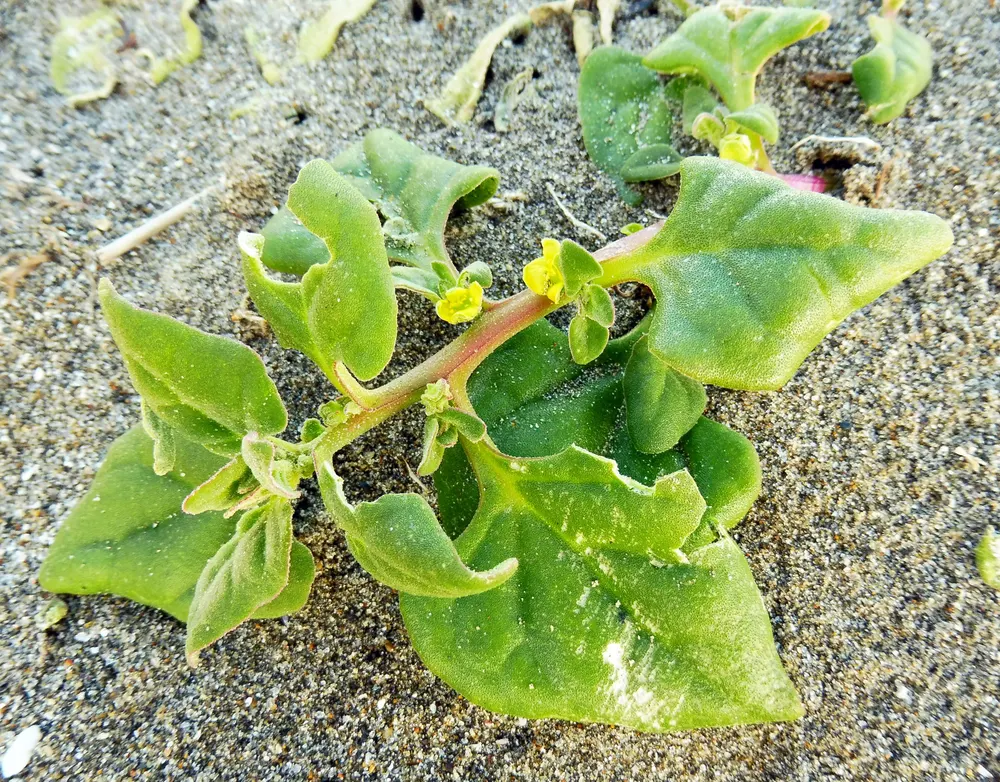
Photo: Mason Brock (Masebrock), Public domain (via Wikimedia Commons)
New Zealand Spinach
Tetragonia tetragonioides
Also known as Kokihi, Warrigal Greens, Botany Bay Spinach, Sea Spinach, Cook's Cabbage
Key benefits
✦Traditional uses
✦New Zealand spinach earned its place in garden history when the naturalists Joseph Banks and Daniel Solander gathered it at Queen Charlotte Sound during Captain Cook's first Pacific voyage in 1770. The crew boiled and ate the sprawling, salt-tolerant leaves to help ward off scurvy on the long sea passage, and the plant was carried home to Kew Gardens soon after, becoming one of the earliest food plants Europe received from the Pacific. Maori communities had long gathered it as kokihi, a wild coastal green valued for food long before European ships ever appeared on the horizon. In the centuries since, cooks in hot climates have leaned on it as a reliable stand-in for true spinach, which tends to wilt and bolt the moment summer heat arrives.
How to grow & use it
✦The full apothecary for New Zealand Spinach
Traditional remedies and step-by-step preparations, a complete growing guide, and how to harvest, dry, and store it, all unlocked with HerbLens Unlimited.
- ✦Remedies & preparations
- ✦ Growing guide
- ✦Harvest & storage
From under $6 a month. Free plant identifications always included.
- ✦Purslane
- ✦Sorrel
- ✦Nettle
- ✦Spinach
- ✦Swiss Chard
“When your spinach has wilted and bolted in the summer heat, and you need a green that thrives right where the sun beats hardest.”
The seed capsules of New Zealand spinach are so hard and slow to sprout that gardeners have soaked them overnight for generations, a trick first noted by the very botanists who carried the plant back from Cook's voyage.
New Zealand spinach contains oxalic acid, much like true spinach and chard, so the traditional practice is to blanch or boil the leaves briefly and discard that cooking water before eating, which softens the leaves and reduces their oxalate content. People who are prone to kidney stones, gout, or who follow a low-oxalate diet should be especially mindful of this and may wish to limit how often they eat it. It is not known to be toxic when prepared this traditional way, but as with any leafy green eaten regularly, it is worth talking with a doctor or qualified healthcare professional about how it fits into your particular diet.