Photo: Unknown authorUnknown author, CC BY 4.0 (via Wikimedia Commons)
Coral Greenbrier
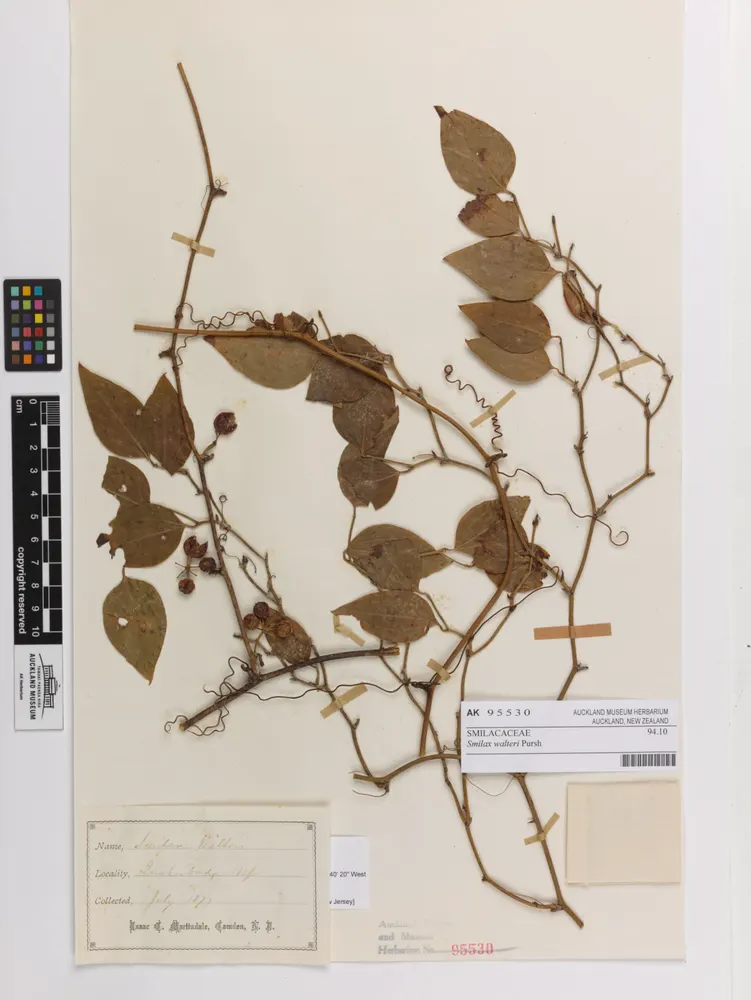
Smilax walteri
Also known as Red-berried Greenbrier, Walter's Greenbrier, Walter's Catbrier
Key benefits
✦Traditional uses
✦Coral greenbrier is one of the quieter members of a genus better known for its famous cousins, the tropical Smilax species that gave the world true sarsaparilla, and Native peoples of the southeastern coastal plain did dig the thick, starchy roots of several regional greenbriers to pound into flour or brew into a reddish, nourishing drink. Smilax walteri itself, though, was noted more for what grew above ground than below it. Its ropes of glossy leaves and prickly canes formed the kind of tangled, thorny thickets that country folk called catbrier or briar patch, valued as living fences and shelter for rabbits, deer, and ground-nesting birds. Come autumn, its clusters of glowing coral-red berries against bare winter stems made it a favorite for cutting and bringing indoors, a small bit of color pulled from the swamp when little else was blooming.
How to grow & use it
✦The full apothecary for Coral Greenbrier
Traditional remedies and step-by-step preparations, a complete growing guide, and how to harvest, dry, and store it, all unlocked with HerbLens Unlimited.
- ✦Remedies & preparations
- ✦ Growing guide
- ✦Harvest & storage
From under $6 a month. Free plant identifications always included.
- ✦Buttonbush
- ✦Virginia sweetspire
- ✦Swamp milkweed
- ✦Possumhaw holly
- ✦American holly
“A ribbon of coral berries strung through a bare winter swamp, the kind of small, bright thing that makes you stop and look twice.”
The species name honors Thomas Walter, an English-born planter and botanist whose 1788 book Flora Caroliniana was one of the very first attempts to catalog the plants of the American South, and Smilax walteri was among the species that carried his name into botanical record.
Coral greenbrier's edibility is not established, so its berries and roots should not be eaten. Its canes carry stiff prickles, and in the wild it can grow near toxic nightshade lookalikes, so take care with identification.