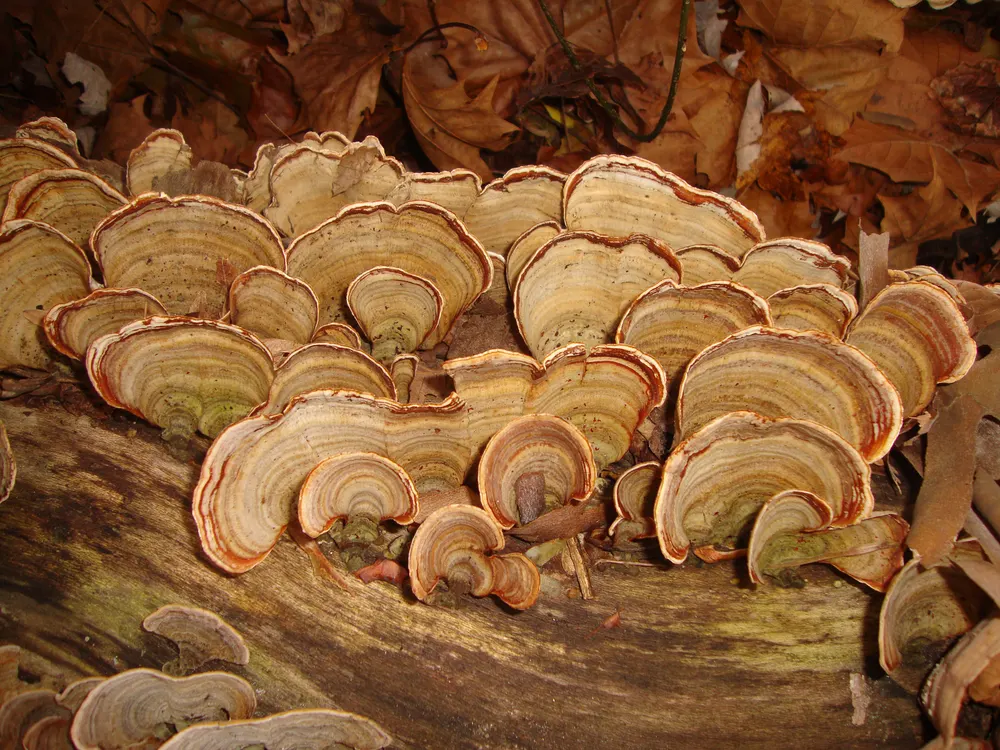
Photo: This image was created by user Martin Livezey (MLivezey) at Mushroom Observer, a source for mycological images.You can contact this user here., CC BY-SA 3.0 (via Wikimedia Commons)
False Turkey Tail
Stereum ostrea
Also known as False Turkeytail, Golden Curtain Crust
Key benefits
✦Traditional uses
✦Stereum ostrea does not carry a history of use as food or medicine the way its famous look-alike, true turkey tail (Trametes versicolor), does. Naturalists and mushroom foragers have long prized it instead as a teaching specimen, one of the first lessons in learning to look past color and shape to the underside of a bracket fungus before making any claim about what it is. Its concentric bands of gold, rust, and cream have made it a favorite subject for nature journaling and forest-floor photography for generations of woodland walkers. Where it truly shines is ecologically: like other bracket fungi, it quietly breaks down fallen hardwood, returning nutrients to the forest soil.
How to grow & use it
✦The full apothecary for False Turkey Tail
Traditional remedies and step-by-step preparations, a complete growing guide, and how to harvest, dry, and store it, all unlocked with HerbLens Unlimited.
- ✦Remedies & preparations
- ✦ Growing guide
- ✦Harvest & storage
From under $6 a month. Free plant identifications always included.
- ✦Often found growing near true Turkey Tail (Trametes versicolor)
- ✦Shares logs with Witch's Butter (Tremella mesenterica)
- ✦Common alongside Split Gill (Schizophyllum commune)
- ✦Foragers seeking turkey tail's traditional herbal reputation should look instead for true Turkey Tail, Trametes versicolor, and confirm the pored (not smooth) underside
“When a fallen log is wearing fans of gold and rust, and you want to practice the quiet art of telling look-alikes apart.”
The easiest way to tell false turkey tail from its famous look-alike is to turn the bracket over. True turkey tail (Trametes versicolor) has a surface of fine, visible pores, while Stereum ostrea is completely smooth underneath, a simple flip that has settled many a foraging debate on the trail.
Stereum ostrea is not known to be toxic, but it is not an edible or medicinal species either. It is easily mistaken for true turkey tail, a different mushroom with an established history of use, so confirm identification before using any wild fungus medicinally.