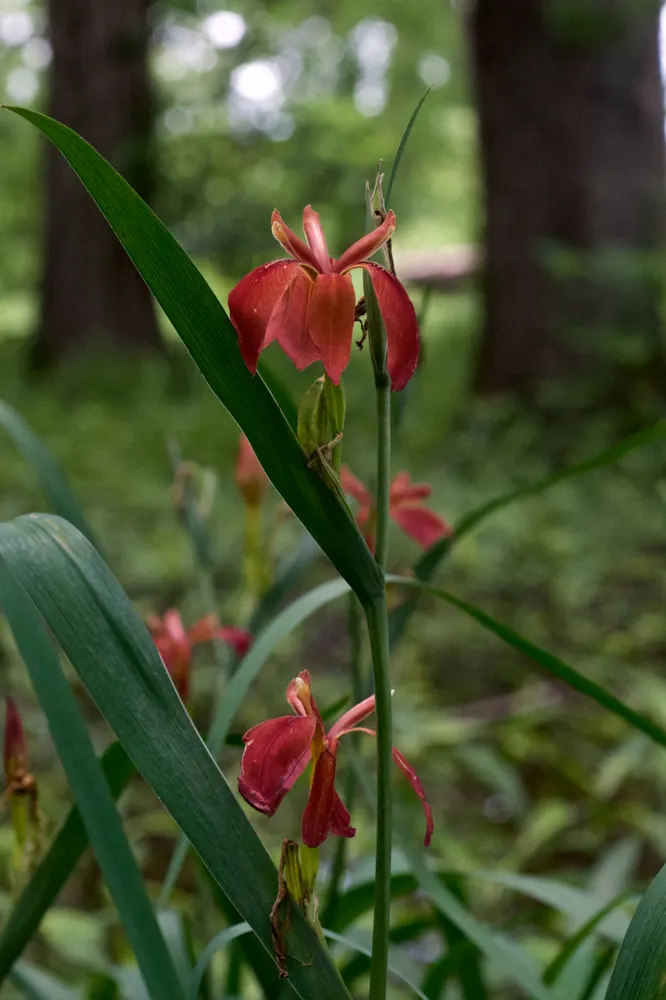
Photo: Eric Hunt, CC BY-SA 4.0 (via Wikimedia Commons)
Copper Iris
Iris fulva
Also known as Louisiana Copper Iris, Red Flag Iris, Copper Fleur-de-lis
Key benefits
✦Traditional uses
✦Iris fulva is a true native of the Louisiana and Gulf Coast wetlands, prized for centuries by those who lived along its bayous for the startling copper and brick red color it brings to an otherwise green marsh in spring, a shade almost unheard of in the iris world. It was admired far more than it was ever ingested, since irises as a family carry irritant compounds that made caution the rule rather than the exception. Some 19th and 20th century plant collectors, most famously in the Louisiana iris hunts of the early 1900s, sought it out specifically to breed into garden hybrids, and it remains one of the parent species behind the beloved Louisiana iris cultivars grown today. Its story is really a garden and wetland story, not a medicine chest one.
How to grow & use it
✦The full apothecary for Copper Iris
Traditional remedies and step-by-step preparations, a complete growing guide, and how to harvest, dry, and store it, all unlocked with HerbLens Unlimited.
- ✦Remedies & preparations
- ✦ Growing guide
- ✦Harvest & storage
From under $6 a month. Free plant identifications always included.
- ✦Pickerelweed
- ✦Cardinal flower
- ✦Louisiana iris cultivars (Iris x nelsonii)
- ✦Iris brevicaulis (for a blue toned Louisiana iris)
- ✦Canna lily (for similar warm color at a pond edge)
“When you want fire kissed color blooming at the water's edge each spring.”
Iris fulva is one of the parent species behind the famous Louisiana iris hybrids, and where its range overlaps with Iris brevicaulis in the wild, the two cross naturally to produce a striking rust red hybrid called Iris x nelsonii, sometimes known as the Abbeville red iris.
All parts of Iris fulva, and especially the rhizome, contain irritant compounds that are toxic if eaten and can cause nausea, vomiting, and digestive upset. The sap can also irritate skin on contact, particularly for those with sensitive skin. This plant is not used in teas, tinctures, or any internal preparation, and it should be kept away from children, pets, and grazing animals. Because there is no established safe internal use, it is not recommended during pregnancy or nursing. Enjoy copper iris as a garden and pond plant rather than a remedy, and speak with a qualified healthcare professional or toxicologist if ingestion is ever suspected.