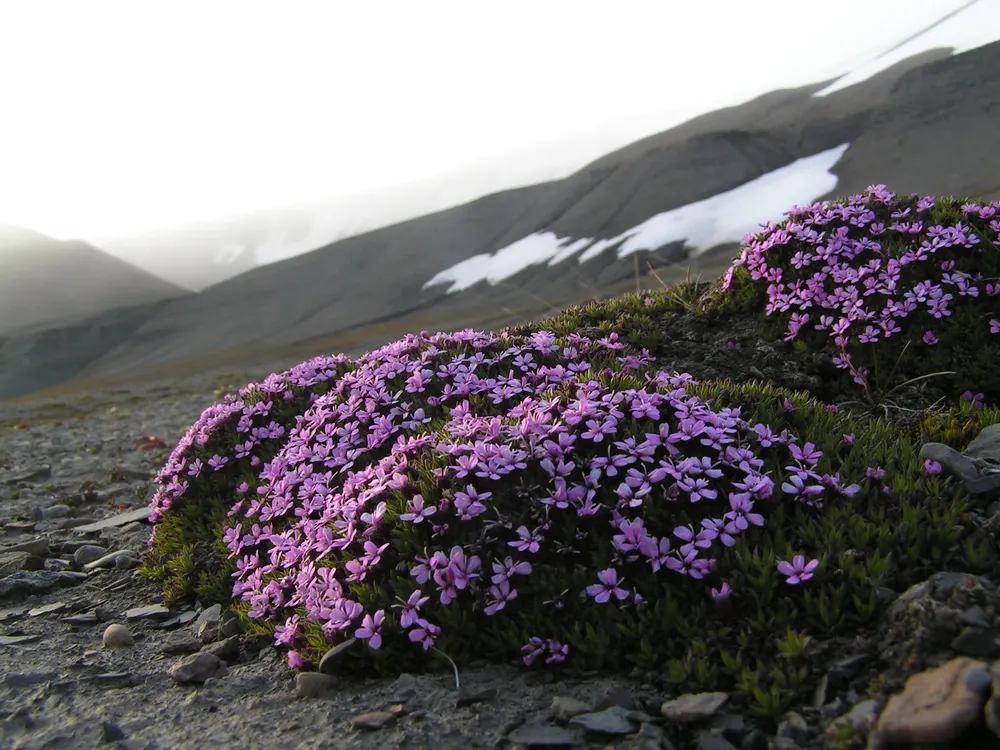
Photo: No machine-readable author provided. Hermanhi assumed (based on copyright claims)., CC BY-SA 3.0 (via Wikimedia Commons)
Moss Campion
Silene acaulis
Also known as Cushion Pink, Moss Pink
Key benefits
✦Traditional uses
✦Moss campion is less a plant of the still room and more a plant of the mountaineer and the naturalist, a tiny, tenacious cushion that has fascinated people for the sheer improbability of its survival on wind-scoured summits and Arctic barrens. In a few far-northern foraging traditions, including among some Arctic peoples, the young leaves and shoots were occasionally gathered in early spring and eaten as a modest green when little else pushed through the thaw, though this was never a widespread or well-documented practice. Its greater legacy is scientific and cultural rather than medicinal: botanists have prized it for generations as a living record of alpine time, and hikers have long taken it as a cheerful, humble sign that they have climbed high enough for the world to turn to rock and sky. It is, above all, a plant admired rather than harvested.
How to grow & use it
✦The full apothecary for Moss Campion
Traditional remedies and step-by-step preparations, a complete growing guide, and how to harvest, dry, and store it, all unlocked with HerbLens Unlimited.
- ✦Remedies & preparations
- ✦ Growing guide
- ✦Harvest & storage
From under $6 a month. Free plant identifications always included.
- ✦Saxifraga (saxifrage)
- ✦Dianthus (alpine pinks)
- ✦Sedum (stonecrop)
- ✦Armeria maritima (sea thrift) for a similar cushion form
- ✦Silene uniflora (sea campion) where a related, easier-growing species is wanted
“For the gardener who dreams in centuries, not seasons.”
Some moss campion cushions on the Arctic tundra have been age-estimated at several hundred years old, making individual plants living witnesses to centuries of alpine weather, one slow ring of growth at a time.
No toxicity is documented for moss campion, but it has no real history of food or medicinal use and can be confused with other wild plants, so it's best admired in the garden or on the trail rather than foraged.