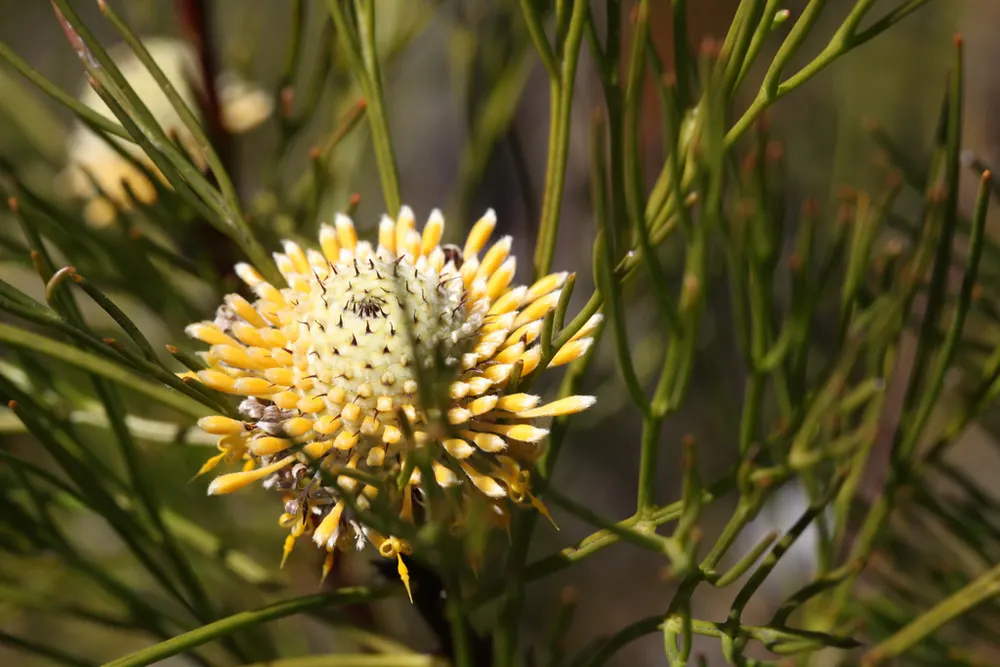
Photo: Moonlight0551 from Australia, CC BY 2.0 (via Wikimedia Commons)
Narrow-leaf Drumsticks
Isopogon anethifolius
Also known as Narrow-leaved Drumsticks, Coneflower, Drumsticks
Key benefits
✦Traditional uses
✦Narrow-leaf Drumsticks belongs to the great Australian family Proteaceae, and it has long been part of the sandstone bushland around Sydney, where its wiry, dill-like foliage and golden drumstick blooms are a familiar sight after a bushwalk. Its real legacy is in the garden and the vase rather than in the medicine chest. Since Australian native plants began entering cultivation in the twentieth century, this species has been prized by bush regenerators and native gardeners for its toughness, its cheerful color, and the way its stiff cone-like seed heads hold their shape for months after cutting, making it a mainstay of dried and fresh native flower arrangements. There is no well documented history of it being used as a food or medicinal herb, so this entry focuses on its garden and ecological story rather than any healing tradition.
How to grow & use it
✦The full apothecary for Narrow-leaf Drumsticks
Traditional remedies and step-by-step preparations, a complete growing guide, and how to harvest, dry, and store it, all unlocked with HerbLens Unlimited.
- ✦Remedies & preparations
- ✦ Growing guide
- ✦Harvest & storage
From under $6 a month. Free plant identifications always included.
- ✦Grevillea
- ✦Banksia
- ✦Kangaroo paw
- ✦Isopogon formosus (rose coneflower)
- ✦Petrophile species
“For a patch of sandstone gold that asks for nothing but sun and good drainage.”
The species name anethifolius means dill leaved, a nod to how its fine, needle thin foliage looks just like the feathery leaves of the dill plant, even though the two are unrelated.
Narrow-leaf drumsticks has no established food or medicinal use, so treat it as an ornamental and habitat plant only, and keep it away from pets and small children.