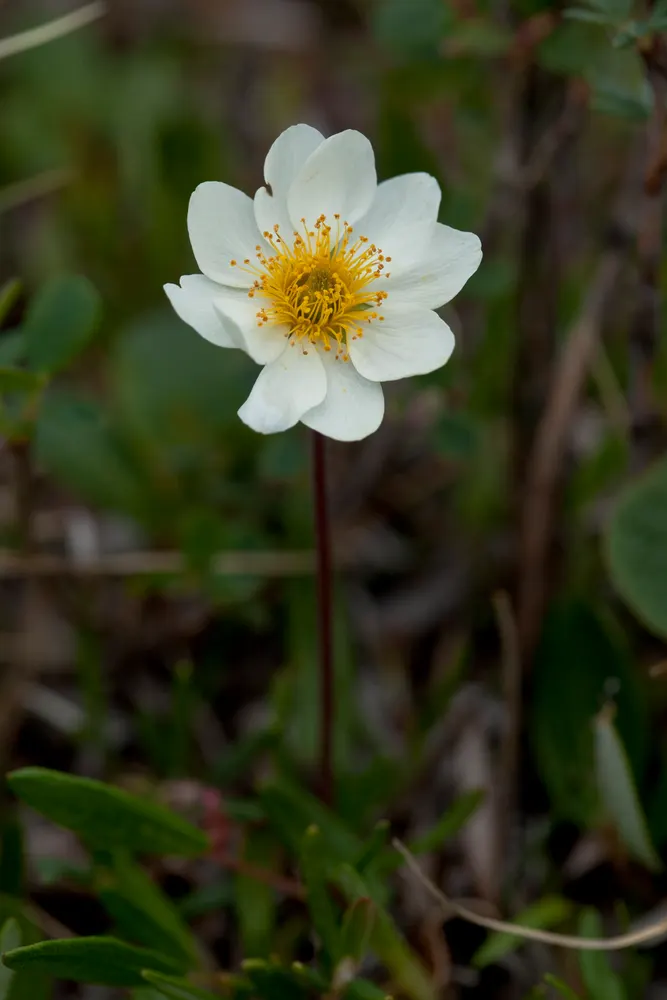
Photo: Denali National Park and Preserve, Public domain (via Wikimedia Commons)
Entire-leaved Mountain Avens
Dryas integrifolia
Also known as Arctic Avens, White Mountain Avens, Entireleaf Avens
Key benefits
✦Traditional uses
✦Long before botanists gave it a Latin name, Dryas integrifolia was simply part of life on the tundra, its low evergreen mats carpeting the ground within reach of nearly every northern camp. Inuit and other Arctic peoples gathered its leaves to brew a warming tea, a welcome comfort through the long cold season when few other green things grew. Caribou herds are drawn to it too, and hunters and travelers learned to read its presence as a sign of good grazing ground. Today it still holds a place of honor as the territorial flower of Canada's Northwest Territories, a small but tenacious plant standing in for an entire landscape.
How to grow & use it
✦The full apothecary for Entire-leaved Mountain Avens
Traditional remedies and step-by-step preparations, a complete growing guide, and how to harvest, dry, and store it, all unlocked with HerbLens Unlimited.
- ✦Remedies & preparations
- ✦ Growing guide
- ✦Harvest & storage
From under $6 a month. Free plant identifications always included.
- ✦Labrador tea
- ✦Rosehip
- ✦Fireweed leaf
- ✦Bearberry (uva ursi) leaf
- ✦Labrador tea leaf
“For the quiet resilience of the tundra, steeped into a single warm cup.”
The genus Dryas lent its name to the Younger Dryas, an abrupt cold snap around 12,900 years ago, because fossil pollen from these tiny tundra plants turned up in sediment layers marking that sudden global chill.
Entire-leaved mountain avens shows no documented toxicity and has a modest history of use as a folk beverage, though it hasn't been studied for safety in pregnancy or alongside medication.