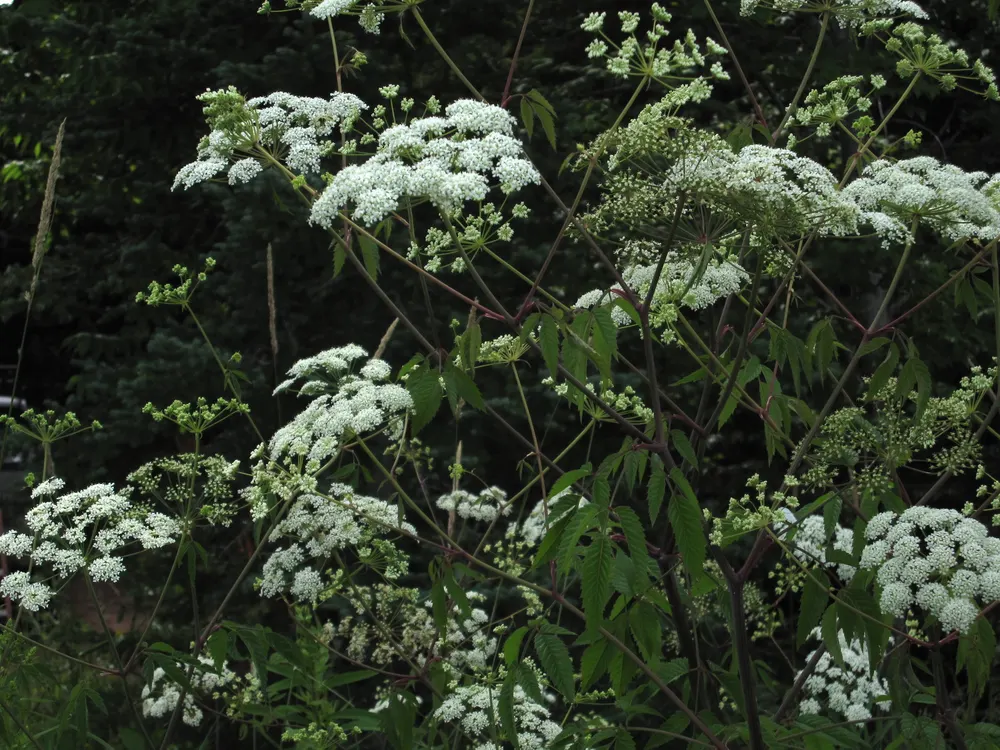
Photo: Williammehlhorn at English Wikipedia, Public domain (via Wikimedia Commons)
Water Hemlock
Cicuta maculata
Also known as Spotted Water Hemlock, Spotted Cowbane, Beaver Poison, Musquash Root
Traditional uses
✦Water hemlock carries no tradition of safe use. It is widely regarded as one of the most toxic plants native to North America, and historical accounts of it are mostly cautionary tales, records of livestock poisoned in wet pastures and foragers who mistook its roots for wild parsnip, its leaves for water parsley, or its clusters of white flowers for the edible Queen Anne's lace it so closely resembles. Some Indigenous communities and early settlers knew the plant well enough to avoid it and to warn others, and its old folk name, beaver poison, reflects a long, hard-won awareness of the danger hiding in innocent-looking wet ground. Any entry it holds in herbal history is as a plant to recognize and give a wide berth, not one to gather or use.
How to grow & use it
✦The full apothecary for Water Hemlock
Traditional remedies and step-by-step preparations, a complete growing guide, and how to harvest, dry, and store it, all unlocked with HerbLens Unlimited.
- ✦Remedies & preparations
- ✦ Growing guide
- ✦Harvest & storage
From under $6 a month. Free plant identifications always included.
“A plant to know by sight and never by taste, water hemlock earns its place in the field guide as a warning, not an invitation.”
Water hemlock is often confused with its lookalike relatives, wild parsnip, water parsley, and the notoriously mistakable Queen Anne's lace, all fellow members of the carrot family. The safest identifying clue is the root: sliced lengthwise, it reveals chambered, tuber-like segments with a yellowish, oily sap that smells faintly of parsnip, a feature that has fooled many a hungry forager into a fatal mistake.
Cicuta maculata, water hemlock, is one of the most acutely poisonous plants in North America and is not safe to ingest in any amount or preparation. It contains cicutoxin, concentrated most heavily in the roots and lower stem, which acts rapidly on the central nervous system and can cause violent seizures, respiratory failure, and death within hours of ingestion; even a small bite of the root has been fatal to adults. The sap can also irritate skin and eyes on contact. It is frequently mistaken for edible relatives in the carrot family, such as wild parsnip or water parsley, and for the similar-looking Queen Anne's lace, which is how most poisonings occur. There is no traditional or modern preparation, tea, tincture, or otherwise, that renders any part of this plant safe to consume, and it should never be foraged, tasted, or used in home remedies under any circumstances. If you suspect water hemlock poisoning in a person or animal, treat it as a medical emergency and contact poison control or emergency services immediately rather than seeking home treatment, and always consult a qualified professional, botanist, or physician for plant identification and any health concerns.