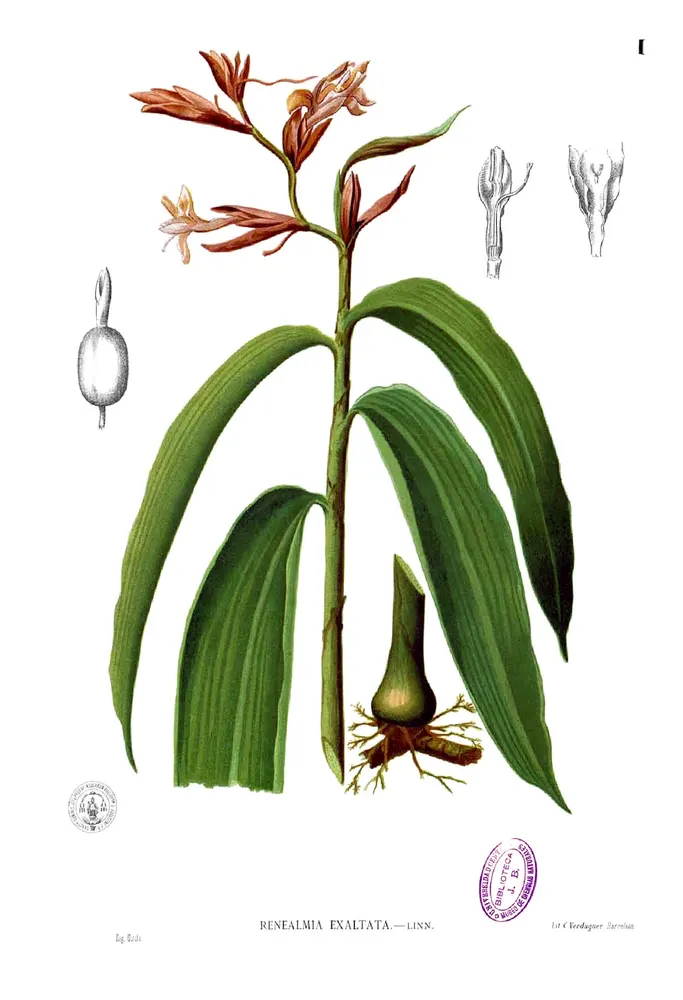
Photo: Francisco Manuel Blanco (O.S.A.), Public domain (via Wikimedia Commons)
Pink Cone Ginger
Renealmia alpinia
Also known as Matandrea, Wild ginger cone, Alpine renealmia
Key benefits
✦Traditional uses
✦Long before it had a place in any field guide, Renealmia alpinia was quietly essential to forest communities from Mexico down through the Amazon basin, its ginger-scented rhizome dug up and simmered into decoctions for stomach troubles, chest colds, and the ache of a heart working too hard. Healers in Colombia and beyond turned to it as a folk treatment for snakebite, a use so persistent across generations that it has since drawn the attention of pharmacologists studying its diterpenes. Its purple-black fruits were never just medicine, though. They found their way into pots of rice and soup for their fragrance, while the broad aromatic leaves were wrapped around food cooking over the fire, much the way banana leaves are used elsewhere in the tropics.
How to grow & use it
✦The full apothecary for Pink Cone Ginger
Traditional remedies and step-by-step preparations, a complete growing guide, and how to harvest, dry, and store it, all unlocked with HerbLens Unlimited.
- ✦Remedies & preparations
- ✦ Growing guide
- ✦Harvest & storage
From under $6 a month. Free plant identifications always included.
- ✦Ginger
- ✦Turmeric
- ✦Cardamom
- ✦Fresh ginger root
- ✦Galangal
“For the deep-forest ginger whose fiery rhizome once stood between a healer and a snakebite.”
The ripe black-purple fruits of Renealmia alpinia were traditionally crushed for a deep purple dye used in textile work and tattoo ink, while its roots yielded a completely different yellow-orange dye, making one plant a two-color palette for forest artisans.
Renealmia alpinia has little modern safety research. Traditionally the rhizome has been prepared as a strong decoction to induce vomiting, so it is not something to use casually, and it should never be relied on as a substitute for antivenom or emergency care after a snakebite.