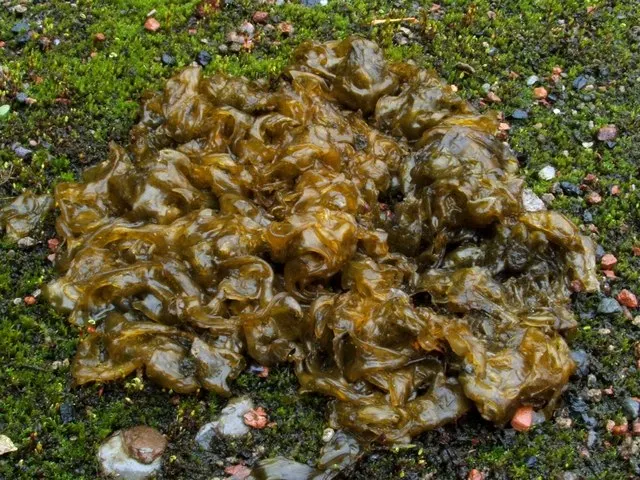
Photo: Lairich Rig, CC BY-SA 2.0 (via Wikimedia Commons)
Star Jelly
Nostoc commune
Also known as Nostoc, Witch's Butter, Star Rot, Ishikurage (Japan), Earth Ear / Di Er (China)
Key benefits
✦Traditional uses
✦Long before it had a Latin name, Nostoc commune was already a familiar sight to anyone who spent their life outdoors, the strange dark jelly that seemed to spring from bare earth overnight after a hard rain. In parts of China it has been gathered for generations as an 'earth vegetable' or 'earth ear,' rinsed and simmered into soups, while in Japan a coastal form known as ishikurage has long been part of home cooking around Kumamoto. Andean communities in Peru and Bolivia have gathered a related lakeside form called llullucha or murmunta as a traditional food, and in other regions it has served as emergency nourishment when little else could be found. Because it asks nothing of the gardener and needs no seed or root, it has always belonged more to the forager's basket than the farmer's field.
How to grow & use it
✦The full apothecary for Star Jelly
Traditional remedies and step-by-step preparations, a complete growing guide, and how to harvest, dry, and store it, all unlocked with HerbLens Unlimited.
- ✦Remedies & preparations
- ✦ Growing guide
- ✦Harvest & storage
From under $6 a month. Free plant identifications always included.
- ✦Ginger
- ✦Scallion
- ✦Goji berry (wolfberry)
- ✦Wood ear mushroom
- ✦Spirulina
“For the quiet mornings after rain, when the bare ground itself turns suddenly to jade-green jelly.”
In European folklore, Nostoc commune was called 'star jelly' or 'star rot' because it seemed to appear overnight after rain in the exact spots where meteors were said to have fallen. In reality, dried colonies that had gone unnoticed for weeks were simply swelling back to life.
Only gather this from clean ground, never roadsides or treated lawns, since it readily absorbs runoff and heavy metals. Trace amounts of BMAA, a compound studied for possible neurological effects, have been found in wild Nostoc, so treat it as an occasional food, and never confuse it with toxic pond algae blooms. Pregnant women, young children, and anyone with a neurological condition are best off avoiding it.