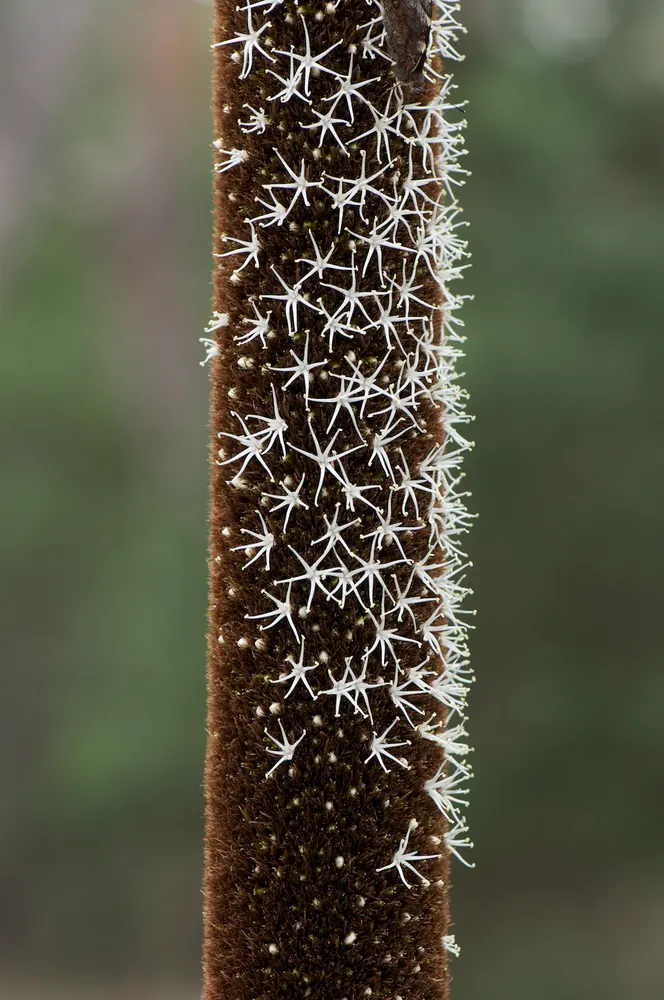
Photo: Eric in SF, CC BY-SA 3.0 (via Wikimedia Commons)
Austral Grass Tree
Xanthorrhoea australis
Also known as Grass Tree, Yacca, Blackboy (older colonial name, now largely retired)
Key benefits
✦Traditional uses
✦For tens of thousands of years, the Austral Grass Tree has stood as one of the most useful plants of southeastern Australia's bushland, valued by Aboriginal peoples less as a medicine and more as a toolkit, a pantry, and a hearth all in one. Its amber resin, gathered from the base of the trunk and gently warmed over a fire, became a powerful natural cement for hafting stone axes and spearheads, patching bark canoes, and sealing water vessels. The tall, arrow-straight flower spikes were fashioned into spear shafts and fire-drills, while the nectar-laden blossoms were steeped in water to make a sweet, refreshing drink. Early European settlers later called it the blackboy and exported its resin by the ton for varnish and dye making, a trade that has since faded as the plant's true value as a slow-growing icon of the Australian bush has come to be better understood and protected.
How to grow & use it
✦The full apothecary for Austral Grass Tree
Traditional remedies and step-by-step preparations, a complete growing guide, and how to harvest, dry, and store it, all unlocked with HerbLens Unlimited.
- ✦Remedies & preparations
- ✦ Growing guide
- ✦Harvest & storage
From under $6 a month. Free plant identifications always included.
- ✦Eucalyptus
- ✦Banksia
- ✦Kangaroo Paw
- ✦Xanthorrhoea preissii (Western grass tree)
- ✦Eucalyptus kino resin
“For the garden that carries the patience of centuries in every inch of trunk.”
The thick 'trunk' of a grass tree isn't wood at all. It is a tightly packed column of old leaf bases cemented together by resin, built up so slowly, often less than a centimeter a year, that a specimen no taller than a person may already be several hundred years old.
The Austral Grass Tree is not established as a food or medicine in modern herbalism, and no internal dose has been determined to be safe, so it should not be eaten, brewed as a medicinal tea, or taken as a supplement. Its resin is highly flammable and, especially as dust, can irritate the skin or airways in some people, so it should be handled with care and never inhaled while being warmed. Wild grass trees are often centuries old, extremely slow to regenerate, and legally protected across much of Australia, so living plants and their resin should never be dug up, cut, or harvested from the bush without explicit permission and the correct permits; choose nursery-grown, ethically propagated specimens instead. As with any traditional plant preparation, especially for children, pregnant or nursing individuals, or anyone with sensitive skin, talk to a qualified healthcare provider or native plant specialist before use.