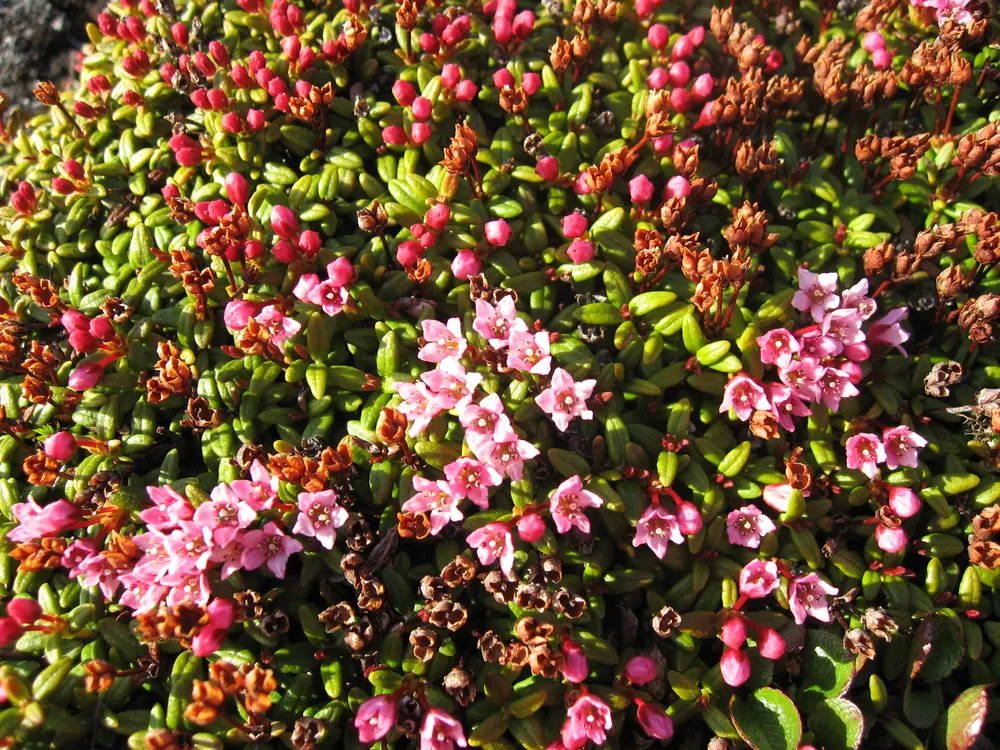
Photo: Kim Hansen, CC BY-SA 3.0 (via Wikimedia Commons)
Alpine Azalea
Loiseleuria procumbens
Also known as Trailing Azalea, Mountain Azalea, Azalea procumbens (old name)
Key benefits
✦Traditional uses
✦Loiseleuria procumbens has no meaningful history as a medicinal or culinary herb. It is one of the toughest little shrubs on earth, a mat forming evergreen that hugs bare rock far above treeline, and its value has always been ecological and ornamental rather than domestic. Alpine botanists have long used it as a living marker of true arctic and alpine tundra, since it thrives only where the ground is cold, thin, and wind scoured, and rock gardeners prize it as one of the smallest true shrubs that can be grown outside its native peaks. There is no established folk tradition of gathering, brewing, or eating any part of this plant.
How to grow & use it
✦The full apothecary for Alpine Azalea
Traditional remedies and step-by-step preparations, a complete growing guide, and how to harvest, dry, and store it, all unlocked with HerbLens Unlimited.
- ✦Remedies & preparations
- ✦ Growing guide
- ✦Harvest & storage
From under $6 a month. Free plant identifications always included.
- ✦Mountain avens (Dryas octopetala)
- ✦Mountain heather (Cassiope species)
- ✦Dwarf Arctic willow
- ✦Creeping thyme (for an easier evergreen alpine mat)
- ✦Dwarf phlox
“When you want a living piece of the wind-scoured tundra, kept alive in miniature at your feet.”
Carl Linnaeus first described this plant in 1753 as Azalea procumbens. It was later given a genus all its own, Loiseleuria, named for the French botanist Jean Louis Auguste Loiseleur-Deslongchamps, so today it stands as the only species in its genus, a true one of a kind shrub barely taller than a teacup.
Alpine azalea has no traditional food or medicinal use and should not be eaten, since related heath-family plants like rhododendron and mountain laurel are toxic. It is slow-growing and often protected in alpine areas, so leave wild plants undisturbed.