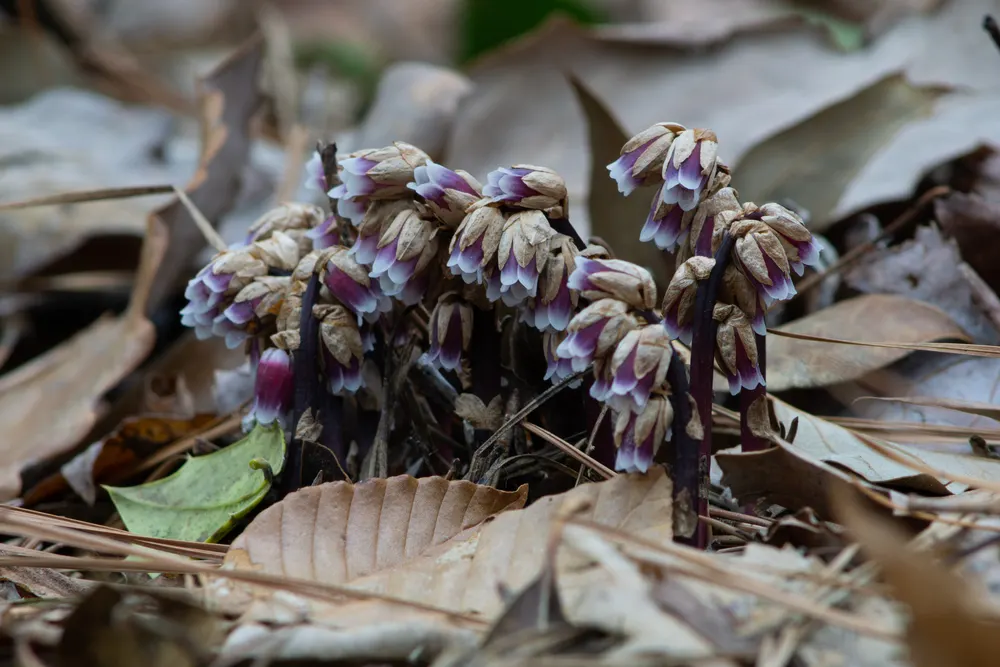
Photo: Jasper Shide, CC0 (via Wikimedia Commons)
Sweet Pinesap
Monotropsis odorata
Also known as Sweet pinedrops, Appalachian pinesap
Key benefits
✦Traditional uses
✦Sweet pinesap has never been a kitchen or medicine-chest herb, and no established tradition of use has come down through Appalachian folk practice or Native herbal medicine for this particular plant. Its real history lives in the notebooks of botanists: it was first formally described in the early 1800s by the South Carolina botanist Stephen Elliott, who found it curious enough to name odorata, 'the fragrant one,' for its faint scent of cloves and violets. Because it makes no chlorophyll of its own and survives only through a hidden partnership with soil fungi, it has always been treasured less as something to gather than as a small, secretive wonder, the kind of find that stops a hiker mid-step on an otherwise bare winter trail. Where it turns up in old field notes and diaries, it is almost always described the same way, as a discovery to admire quietly and leave exactly where it grows.
How to grow & use it
✦The full apothecary for Sweet Pinesap
Traditional remedies and step-by-step preparations, a complete growing guide, and how to harvest, dry, and store it, all unlocked with HerbLens Unlimited.
- ✦Remedies & preparations
- ✦ Growing guide
- ✦Harvest & storage
From under $6 a month. Free plant identifications always included.
- ✦Indian pipe (Monotropa uniflora)
- ✦Pinesap (Monotropa hypopitys)
- ✦None. Sweet pinesap has no established medicinal or culinary use, so no true substitute applies
“For the rare hush of finding a flower that never bothered with sunlight, blooming low in the winter leaf litter when almost nothing else dares to.”
Sweet pinesap belongs to the same strange, chlorophyll-free family as the better-known Indian pipe. Instead of making its own food from sunlight, it taps into underground fungal networks that are themselves wired into the roots of nearby trees, essentially drawing off sugars the trees made and traded to the fungi for other nutrients, a plant living entirely off of a borrowed pantry underground.
Sweet pinesap has no documented use as food or medicine and should not be eaten or applied to the skin. It is rare, depends on an underground fungal network to survive, and does not regrow once picked, so it is often protected and best left in place.