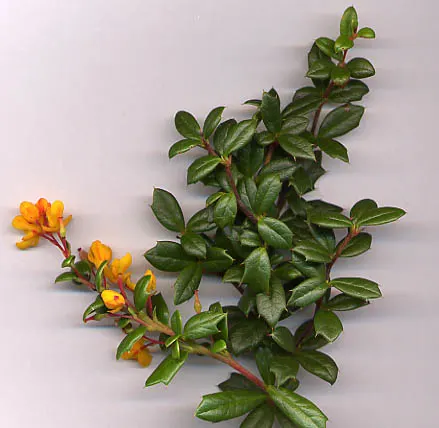
Photo: CC BY-SA 3.0 (via Wikimedia Commons)
Darwin's Barberry
Berberis darwinii
Also known as Darwin's Barberry, Michay, Calafate Amarillo
Key benefits
✦Traditional uses
✦Long before it ever reached a European garden, Darwin's barberry grew wild across Patagonia, where its small orange berries were gathered by hand and eaten fresh or dried for the leaner months. Charles Darwin himself collected the plant near the Strait of Magellan in 1834, and it carried his name back to English nurseries within a few decades. Like its cousins Berberis vulgaris and Oregon grape, the yellow inner bark of the stems and roots is rich in berberine, an intensely bitter alkaloid, and folk herbalists in its native range have traditionally steeped it as a bitter tonic to settle a sluggish stomach after heavy meals. The berries themselves have a long, simple history as a tart trailside snack and a base for jams and cordials.
How to grow & use it
✦The full apothecary for Darwin's Barberry
Traditional remedies and step-by-step preparations, a complete growing guide, and how to harvest, dry, and store it, all unlocked with HerbLens Unlimited.
- ✦Remedies & preparations
- ✦ Growing guide
- ✦Harvest & storage
From under $6 a month. Free plant identifications always included.
- ✦Rosehip
- ✦Hawthorn berry
- ✦Ginger
- ✦Barberry (Berberis vulgaris)
- ✦Oregon grape (Mahonia aquifolium)
“For a hedgerow gift of orange jewels and old sailor's stories, gathered the way Patagonian families always have.”
The shrub's dense, spiny growth made it a favorite for stock-proof hedging in Victorian Britain, and it later escaped so successfully into the wild that it is now considered an invasive weed across parts of New Zealand, the very success Darwin himself might have appreciated as natural selection in action.
The bark and root contain berberine, which should be avoided during pregnancy and breastfeeding and can interact with blood thinners and diabetes medication; it is not recommended for infants or young children. The stems carry sharp spines, and only fully ripe berries should be eaten, since unripe ones can upset the stomach.