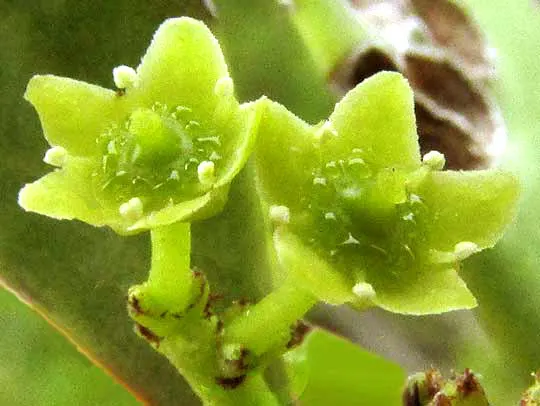
Photo: Gaiacoyote, CC0 (via Wikimedia Commons)
Florida Mayten
Maytenus phyllanthoides
Also known as Guttapercha Mayten, Mangle Dulce, Sweet Mangrove
Key benefits
✦Traditional uses
✦Along the salt flats and mangrove edges of the Gulf Coast, Maytenus phyllanthoides has long been woven into coastal life, known to the Seri people of Sonora and to Mexican shoreline communities as mangle dulce, the sweet mangrove. Its leaves, and the milky sap that beads up inside a broken twig, were traditionally applied as a simple field remedy for minor scrapes and skin irritation. Ranchers and wildlife have leaned on it too, since goats, deer, and livestock browse its tough evergreen leaves even where little else will grow. Today it endures mostly as a quietly resilient shoreline shrub, valued as much for holding the dune together as for any remedy drawn from its leaves.
How to grow & use it
✦The full apothecary for Florida Mayten
Traditional remedies and step-by-step preparations, a complete growing guide, and how to harvest, dry, and store it, all unlocked with HerbLens Unlimited.
- ✦Remedies & preparations
- ✦ Growing guide
- ✦Harvest & storage
From under $6 a month. Free plant identifications always included.
- ✦Aloe vera
- ✦Calendula
- ✦Chaparral
- ✦Witch hazel
- ✦Yarrow
“For the tough, quiet green that holds the line where desert meets tide.”
Break a young twig and it weeps a faint, rubbery sap, which is how this shrub earned the nickname guttapercha mayten. The Seri people of Sonora are said to have chewed this sap much like gum, long before the rise of the store-bought kind.
There is little modern safety research on Maytenus phyllanthoides itself, and its traditional use has historically been external only, as a wash or poultice for minor skin troubles. It has not been established as safe to ingest, and other members of the Celastraceae family are known to contain strong bioactive compounds, so this plant should not be eaten or brewed as an internal tea. Anyone who is pregnant, nursing, managing a medical condition, or taking medication should speak with a qualified herbalist or healthcare provider before using any part of this plant, and it is always wise to patch test before applying anything to the skin.