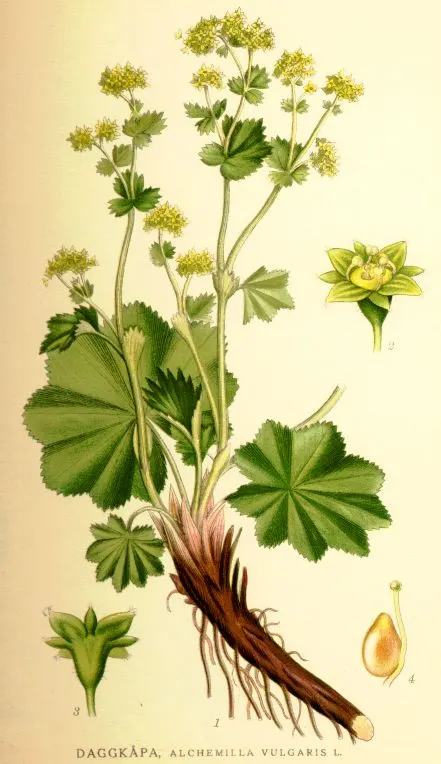
Photo: Carl Axel Magnus Lindman, Public domain (via Wikimedia Commons)
Lady's Mantle
Alchemilla vulgaris
Also known as Alchemilla, Our Lady's Mantle, Lion's Foot, Bear's Foot, Dewcup
Key benefits
✦Traditional uses
✦Lady's mantle takes its Latin name, Alchemilla, from the Arabic word for alchemy, because medieval alchemists prized the perfect beads of dew that collect on its leaves each morning, believing the water held a purer, almost magical essence. For centuries afterward, European herbalists turned to the leaves as a woman's herb above all else, traditionally brewed into teas to help ease heavy or painful cycles, support recovery after childbirth, and settle the discomforts of menopause. It also earned a place in the kitchen garden apothecary as a gentle digestive tonic, and its astringent leaves were traditionally applied to minor cuts, grazes, and irritated skin to help draw tissues closed and calm inflammation.
How to grow & use it
✦The full apothecary for Lady's Mantle
Traditional remedies and step-by-step preparations, a complete growing guide, and how to harvest, dry, and store it, all unlocked with HerbLens Unlimited.
- ✦Remedies & preparations
- ✦ Growing guide
- ✦Harvest & storage
From under $6 a month. Free plant identifications always included.
- ✦Raspberry leaf
- ✦Chamomile
- ✦Nettle
- ✦Yarrow
- ✦Shepherd's purse
“For the quiet, steadying support a woman's body asks for, month after month.”
The dew-like beads that appear on lady's mantle leaves each morning are not just dew. The leaf's structure pushes out droplets of water from its own tissues in a process called guttation, and medieval alchemists collected this shimmering liquid believing it was the purest water in nature, perfect for their experiments in turning base metals into gold.
Lady's mantle is high in tannins, so it's best used in modest amounts since too much can cause stomach upset or reduce mineral absorption. It has a traditional reputation as a uterine tonic and is generally avoided during pregnancy.