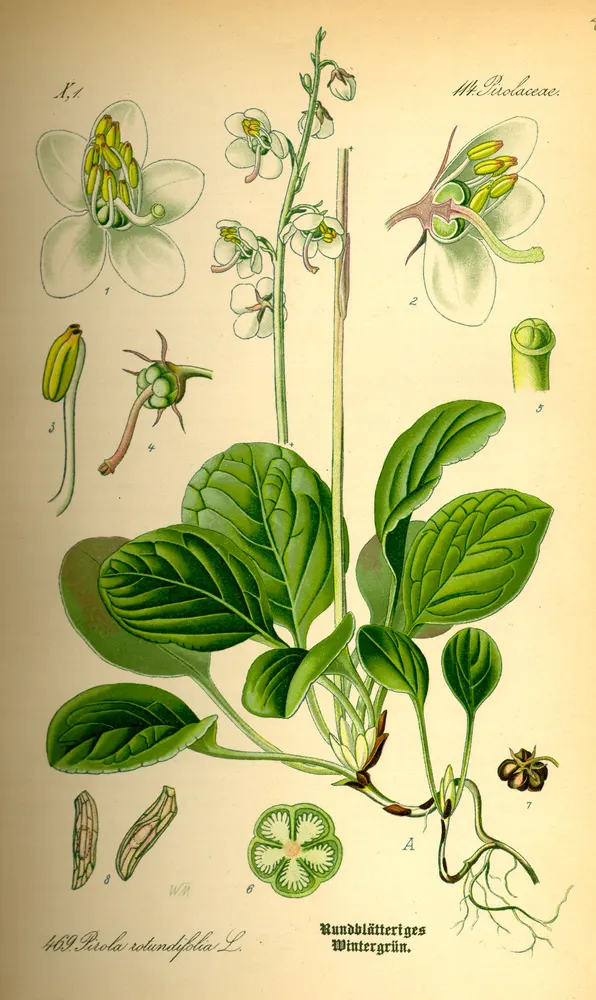
Photo: Public domain (via Wikimedia Commons)
Round-Leaved Wintergreen
Pyrola rotundifolia
Also known as Shinleaf, Round-leaved pyrola, English wintergreen
Key benefits
✦Traditional uses
✦Round-leaved wintergreen has quietly served woodland travelers and herbalists for generations as a cool, mildly astringent leaf for the skin. Its old country name, shinleaf, comes from the simple practice of pressing a fresh leaf against a bruised or scraped shin to take the sting out. Native American communities and later 19th-century Eclectic physicians in America used infusions of the leaf as a wash for cuts, swellings, and sore or tired eyes. It never became a kitchen staple, but in the hush of the pine woods it earned a quiet reputation as a dependable little first aid plant.
How to grow & use it
✦The full apothecary for Round-Leaved Wintergreen
Traditional remedies and step-by-step preparations, a complete growing guide, and how to harvest, dry, and store it, all unlocked with HerbLens Unlimited.
- ✦Remedies & preparations
- ✦ Growing guide
- ✦Harvest & storage
From under $6 a month. Free plant identifications always included.
- ✦Plantain
- ✦Yarrow
- ✦Calendula
- ✦Witch hazel
- ✦Self-heal (Prunella vulgaris)
“For a cool, quiet remedy pressed from the shade of old pines, saved for small scrapes and summer bruises.”
Despite sharing the name wintergreen, round-leaved wintergreen is not related to the plant behind wintergreen flavoring and oil of wintergreen, Gaultheria procumbens. The two simply picked up the same common name from woodland foragers, a mix-up that has confused herb gatherers for centuries.
Round-leaved wintergreen has a long history as a gentle folk remedy and is not known to be toxic in traditional external use, but it should never be confused with Gaultheria procumbens (also commonly called "wintergreen"), an unrelated plant whose oil contains concentrated methyl salicylate and can be dangerous even in small amounts. Because Pyrola rotundifolia has not been closely studied by modern science, reliable safety data on internal use, dosage, and drug interactions is limited, so any internal use should be kept occasional and minimal. It is best avoided during pregnancy and breastfeeding due to this lack of research. As always, speak with a qualified healthcare provider or herbalist before using this or any herb medicinally, especially if you are pregnant, nursing, or taking other medications.