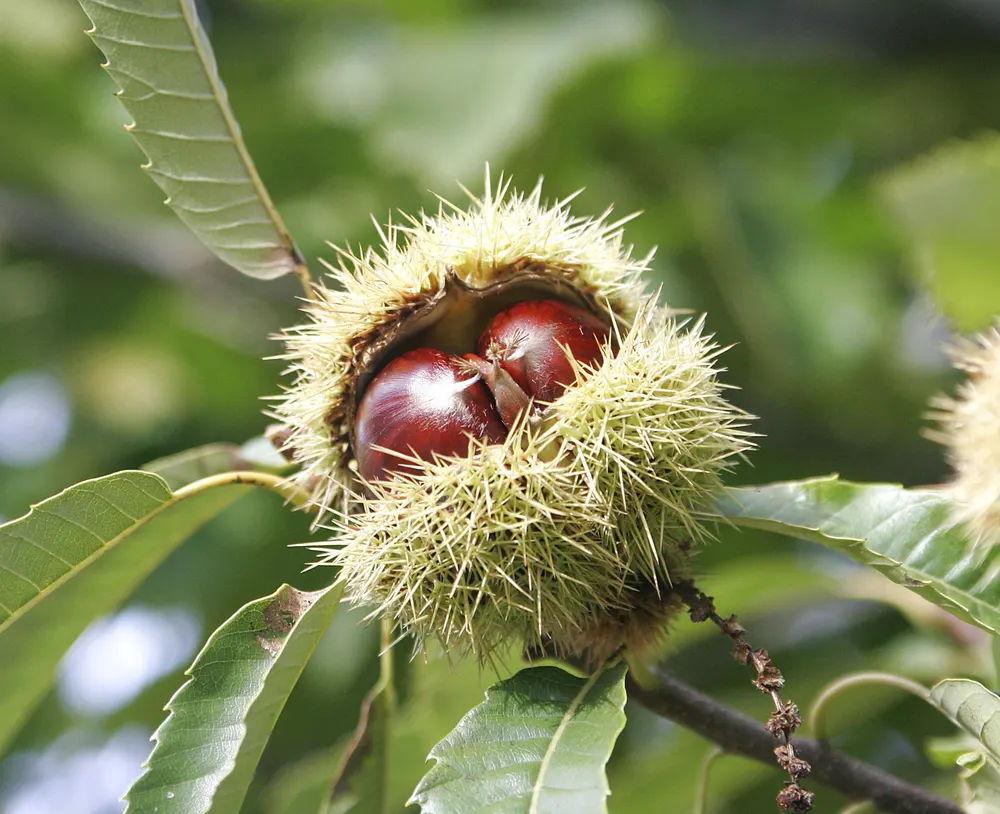
Photo: Fir0002, GFDL 1.2 (via Wikimedia Commons)
Sweet Chestnut
Castanea sativa
Also known as Spanish Chestnut, European Chestnut, The Bread Tree
Key benefits
✦Traditional uses
✦For thousands of years, sweet chestnut has been a tree of survival as much as medicine. In the mountain villages of Corsica, Tuscany, and the Cevennes, whole communities once depended on dried, ground chestnuts as their bread and porridge through long winters, earning it the old nickname 'the bread tree.' Alongside the nuts, the broad summer leaves found their own quiet place in European folk herbalism, gathered and dried to make a soothing, astringent tea traditionally used for coughs, sore throats, and the rattling irritation of whooping cough. Herbalists valued the leaf for its tannins, which were thought to tighten and calm irritated tissue, while the nuts themselves were simply treasured as honest, warming food for hard seasons.
How to grow & use it
✦The full apothecary for Sweet Chestnut
Traditional remedies and step-by-step preparations, a complete growing guide, and how to harvest, dry, and store it, all unlocked with HerbLens Unlimited.
- ✦Remedies & preparations
- ✦ Growing guide
- ✦Harvest & storage
From under $6 a month. Free plant identifications always included.
- ✦Thyme
- ✦Mullein
- ✦Honey
- ✦Oak leaf (for tannin content)
- ✦Mullein leaf (for soothing respiratory teas)
“For the smell of roasting nuts on a cold evening, and a tree old enough to have sheltered centuries of travelers before you.”
The Hundred-Horse Chestnut on Sicily's Mount Etna is thought to be over 2,000 years old and so wide that, according to legend, a queen and her hundred knights once sheltered from a storm beneath its single canopy.
Sweet chestnuts are a safe, well-tolerated food for most people, though the leaf tea's tannins can be harsh on a sensitive stomach if used daily. Don't confuse this tree with horse chestnut (Aesculus hippocastanum), an unrelated tree whose raw nuts, bark, leaves, and flowers are toxic.