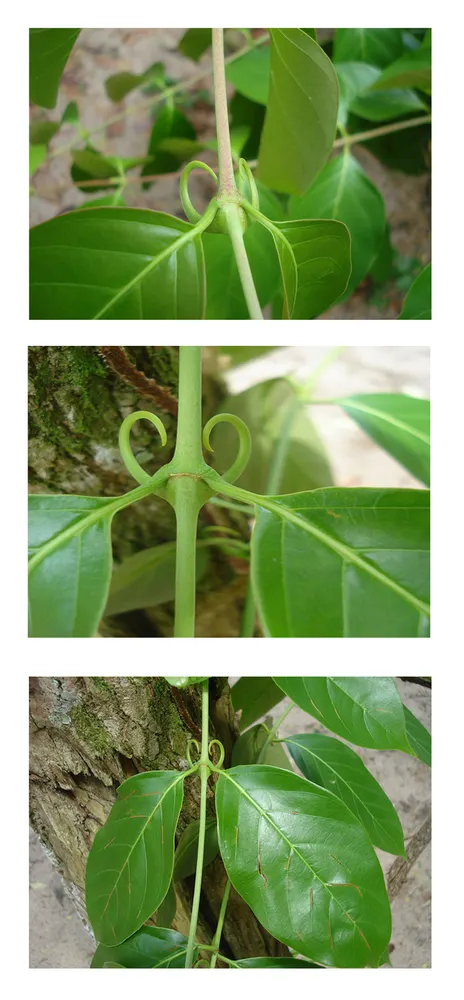
Photo: Vangeliq.petrova, CC BY-SA 4.0 (via Wikimedia Commons)
Cat's Claw
Uncaria tomentosa
Also known as Uña de Gato, Life-Giving Vine of Peru, Samento
Key benefits
✦Traditional uses
✦Deep in the Amazon, the Asháninka and other indigenous peoples have turned to cat's claw for centuries, simmering its tough inner bark into a dark decoction to ease sore joints, settle the stomach, and help the body recover after illness. Healers valued it as a general tonic for weathering the rainforest's fevers and infections, and it was often shared communally as a strengthening drink. Its reputation traveled with Spanish colonizers and eventually reached Western herbalism in the twentieth century, where it became one of South America's most sought-after botanical exports. The vine's hooked thorns, which let it scale trees toward sunlight, gave it both its common name and a certain folk mystique as a plant that claws its way toward the light.
How to grow & use it
✦The full apothecary for Cat's Claw
Traditional remedies and step-by-step preparations, a complete growing guide, and how to harvest, dry, and store it, all unlocked with HerbLens Unlimited.
- ✦Remedies & preparations
- ✦ Growing guide
- ✦Harvest & storage
From under $6 a month. Free plant identifications always included.
- ✦Turmeric
- ✦Ginger
- ✦Echinacea
- ✦Reishi Mushroom
- ✦Turmeric
“When joints ache and the body could use a steady, ancient ally from the rainforest.”
Cat's claw earned its name from the small, curved thorns along its stem, which the plant uses like grappling hooks to pull itself up through the rainforest canopy toward the light, the very same thorns that make harvesting it a careful, gloved affair.
Cat's claw is traditionally avoided during pregnancy and breastfeeding, and by people with autoimmune conditions such as lupus or rheumatoid arthritis, since it may stimulate the immune system. It can also interact with immunosuppressant medication, blood thinners, and blood pressure medications.