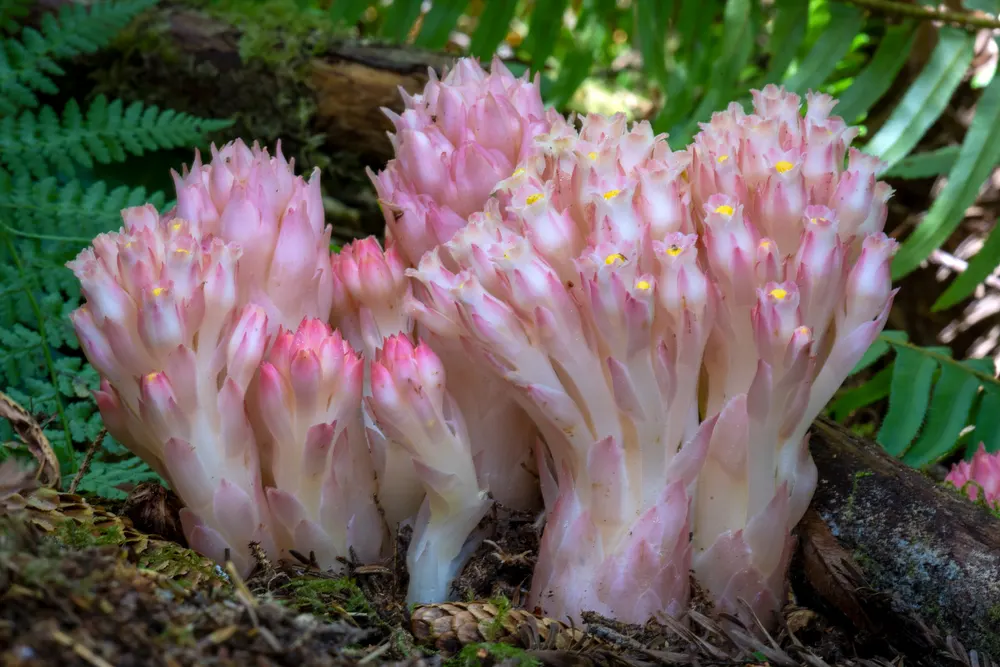
Photo: Alan Rockefeller, CC BY-SA 4.0 (via Wikimedia Commons)
Gnome Plant
Hemitomes congestum
Also known as Gnome plant, Cone plant, Small-flowered gnome plant
Key benefits
✦Traditional uses
✦Unlike many of its Monotropoideae cousins, such as the well-known Indian pipe, Hemitomes congestum does not carry a documented history of use in traditional herbalism, food, or medicine among the peoples of the Pacific Northwest. What has made it treasured instead is its strangeness: entirely without green leaves or chlorophyll, it survives by tapping into the shared underground network of mycorrhizal fungi that connects it, invisibly, to the roots of conifers overhead. Foragers, naturalists, and mushroom hunters have long prized simply finding it, a small, waxy, pinkish knot pushing up through the duff like something left behind by an unseen hand. Its value has always been the encounter, not the harvest.
How to grow & use it
✦The full apothecary for Gnome Plant
Traditional remedies and step-by-step preparations, a complete growing guide, and how to harvest, dry, and store it, all unlocked with HerbLens Unlimited.
- ✦Remedies & preparations
- ✦ Growing guide
- ✦Harvest & storage
From under $6 a month. Free plant identifications always included.
“For the moment you part the needle duff and find a small, pale knot of flesh where no plant should be able to grow at all.”
Hemitomes congestum gets all of its carbon and nutrients secondhand, by tapping into mycorrhizal fungi that are simultaneously feeding sugars to nearby conifers. Botanists call this epiparasitism, and it means the gnome plant is, in effect, quietly stealing sunlight energy that a fir or hemlock tree worked to capture, without ever growing a single green leaf of its own.
This plant has no history of food or medicinal use and no reliable safety data, so it should never be eaten. It depends entirely on an underground fungal network and dies if picked or disturbed, so it is best enjoyed only by sight.