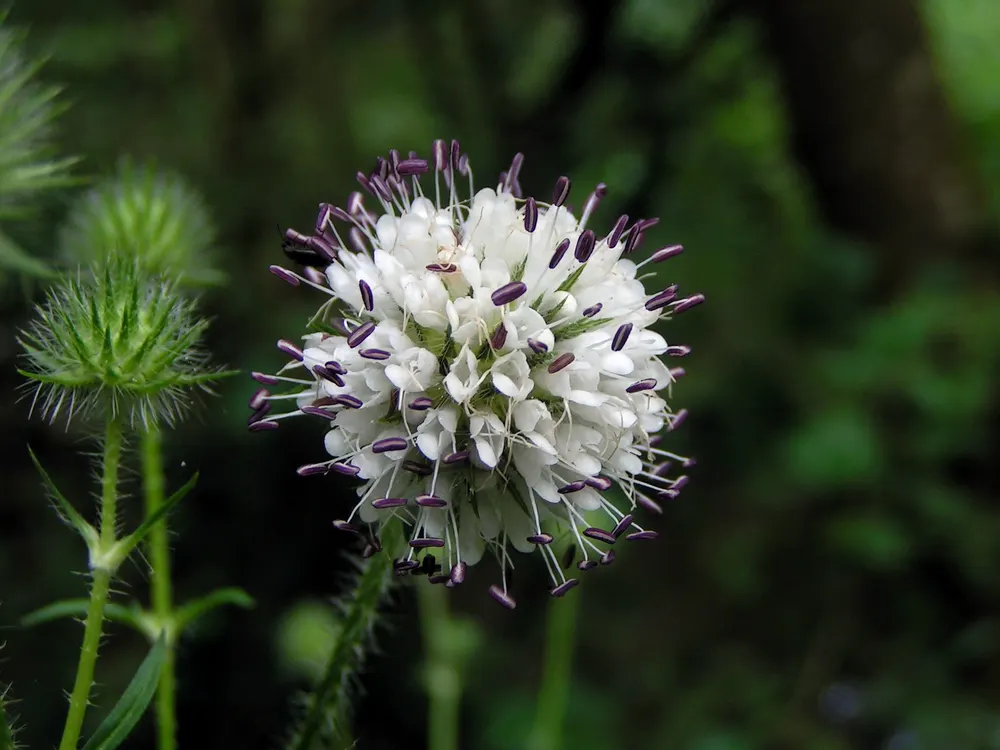
Photo: No machine-readable author provided. Pethan assumed (based on copyright claims)., CC BY-SA 3.0 (via Wikimedia Commons)
Small Teasel
Dipsacus pilosus
Also known as Small Teasel, Shepherd's Rod (regional, shared with other teasels), Hairy Teasel
Key benefits
✦Traditional uses
✦Small Teasel is the shy, shade-loving cousin of Fuller's Teasel, the plant once prized for raising the nap on woven wool. Unlike its stiff-bracted relative, Dipsacus pilosus never found a place in the cloth trade or in the herbalist's cabinet, and it has no meaningful record of medicinal or culinary use. What it earned instead was a quieter reputation among naturalists and foragers as a marker of old forest, a small pale flower nodding in the dappled corners of woods that have stood for a very long time. Its value has always been more botanical curiosity and wildlife forage than remedy.
How to grow & use it
✦The full apothecary for Small Teasel
Traditional remedies and step-by-step preparations, a complete growing guide, and how to harvest, dry, and store it, all unlocked with HerbLens Unlimited.
- ✦Remedies & preparations
- ✦ Growing guide
- ✦Harvest & storage
From under $6 a month. Free plant identifications always included.
- ✦Foxglove (as a woodland-edge companion)
- ✦Wood avens (as a shade-garden companion)
- ✦Fuller's Teasel (for dried seed-head arrangements)
“For the quiet, shaded corners where its famous cousin would never grow, and old woodland keeps its own slow time.”
In parts of Britain, Small Teasel is treated as an indicator of ancient woodland, its presence in a damp clearing often hinting that the trees around it have stood, largely undisturbed, for centuries.
Small teasel has no established food or medicinal use and no known safe preparation. It is a different species from Fuller's teasel or the teasel used in Chinese medicine, so do not treat it the same way.