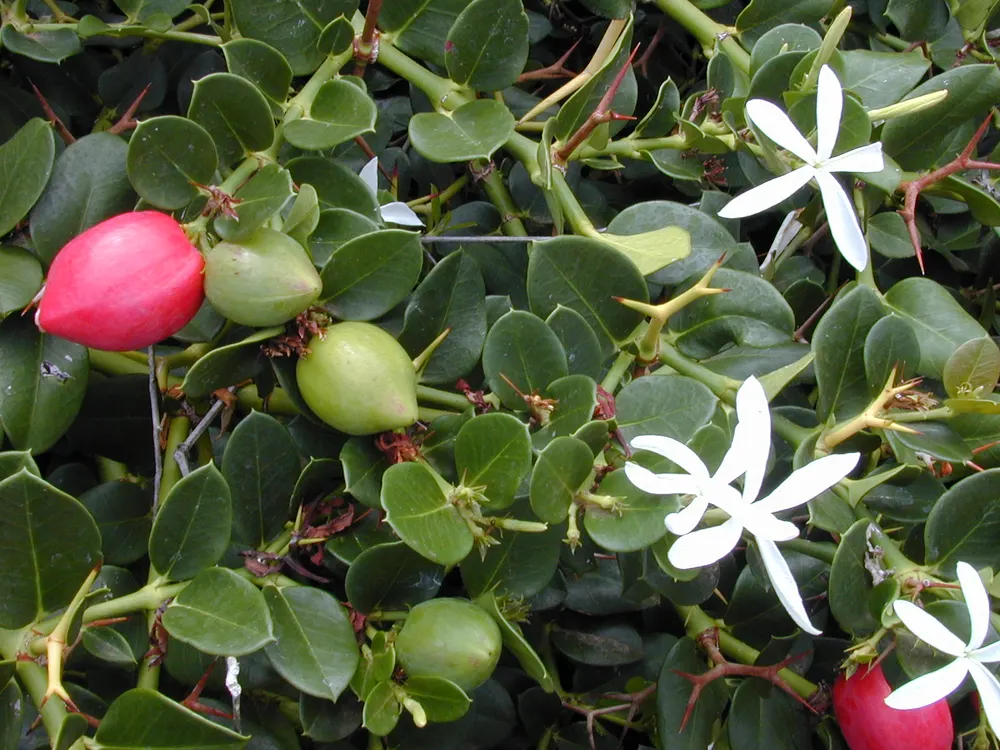
Photo: Forest & Kim Starr, CC BY 3.0 (via Wikimedia Commons)
Natal Plum
Carissa macrocarpa
Also known as Natal Plum, Amatungulu, Big Num-Num, Noem-Noem, Carissa
Key benefits
✦Traditional uses
✦Along South Africa's coast, the Xhosa and Zulu peoples have long gathered the ripe, crimson fruit of the Natal plum straight from the dune scrub, eating it fresh or simmering it down into a tart preserve to see them through the year. Its dense, spiny branches made it a natural choice for living fences and kraal boundaries well before wire fencing arrived, a practice still visible along the KwaZulu-Natal coastline today. European settlers later brought the shrub into cultivation as an ornamental hedge, drawn as much to its perfumed, jasmine-like blossoms as to its fruit. It remains, first and foremost, a garden and orchard plant rather than a medicine chest herb.
How to grow & use it
✦The full apothecary for Natal Plum
Traditional remedies and step-by-step preparations, a complete growing guide, and how to harvest, dry, and store it, all unlocked with HerbLens Unlimited.
- ✦Remedies & preparations
- ✦ Growing guide
- ✦Harvest & storage
From under $6 a month. Free plant identifications always included.
- ✦Ginger
- ✦Citrus zest
- ✦Cinnamon
- ✦Cranberry
- ✦Kumquat
“When you want a thorny, fragrant hedge that also hands you a sweet-tart harvest come summer.”
The Natal plum belongs to the same botanical family, Apocynaceae, as oleander and periwinkle, which explains its curious double nature: a fruit sweet and safe enough for jam, growing on a plant whose leaves, stems, and unripe fruit carry the same kind of cardiac glycosides found in its more infamous cousins.
Only the fully ripe, dark colored fruit is edible; the leaves, stems, and unripe green fruit contain a milky sap with cardiac glycosides that can cause nausea, vomiting, or heart rhythm problems if eaten, so anyone on heart medication should be especially careful around this plant. The sap can also irritate skin and eyes, and the branches have sharp thorns, so keep children and pets away from anything but ripe fruit.