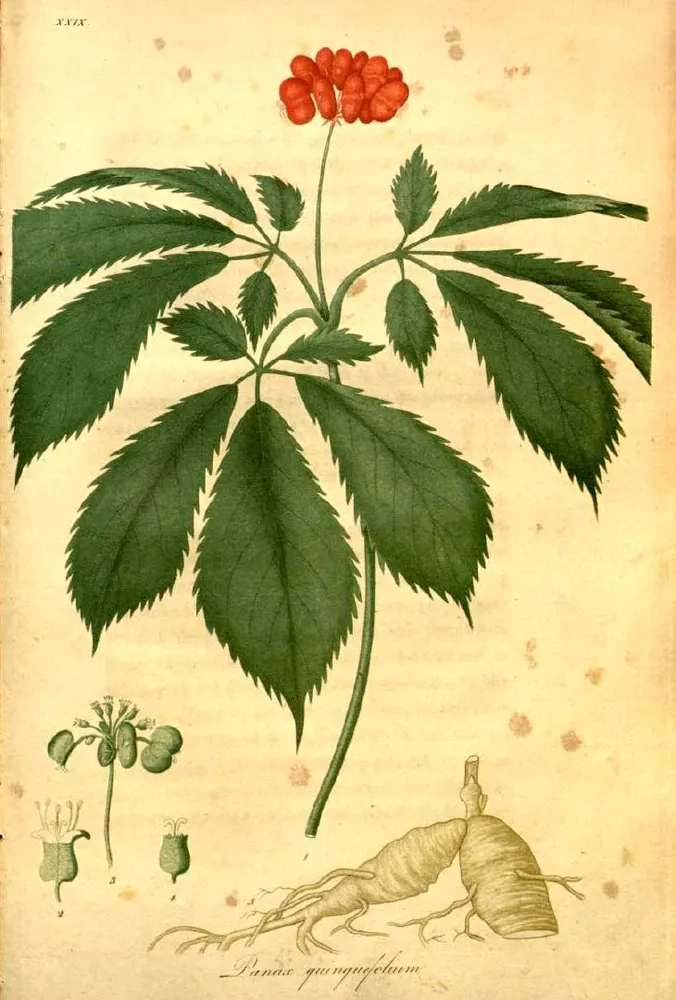
Photo: Jacob Bigelow (1786-1879), text and coloured engravings, Public domain (via Wikimedia Commons)
American Ginseng
Panax quinquefolius
Also known as Sang, Man Root, Five-Fingers, Western Ginseng, Xi Yang Shen
Key benefits
✦Traditional uses
✦Long before it appeared on apothecary shelves, American ginseng grew quietly in the cool shade of Appalachian and northeastern forests, its gnarled, man-shaped root treasured by the Cherokee, Iroquois, and Seneca peoples as a tonic for vitality, digestion, and recovery from illness. By the 1700s, traders had discovered that this root, unrelated in trade history to Asian ginseng but a botanical cousin, was prized in China for its cooling, restorative qualities, and it became one of colonial America's first great export goods, gathered by lantern light from the wild woods and shipped across the ocean. Herbalists in both traditions came to regard the root as a slow-building tonic, something taken over weeks to help the body meet stress and fatigue with steadier footing, rather than a quick fix.
Growing guide
✦Fresh to dried
✦Traditional preparations
✦Simmered Ginseng Root Tea
The traditional way to draw the tonic qualities out of a tough forest root, gently simmered rather than merely steeped.
How it's made. Traditionally, 1 to 2 grams of thinly sliced dried root (about a small teaspoon) is simmered gently in 250 ml of water for 15 to 20 minutes, covered, then strained and sipped.
Ginseng Honey Infusion
A gentler, sweeter way to take the root, favored for easing it into a daily rhythm a spoonful at a time.
How it's made. Traditionally, a few thin slices of dried root are steeped in a small jar of raw honey for two to three weeks, then a small spoonful is stirred into warm water or tea.
- ✦Astragalus
- ✦Licorice root
- ✦Schisandra
- ✦Codonopsis
- ✦Eleuthero
“For the long, quiet work of steadying a body worn thin by too much and not enough rest.”
American ginseng once traveled the opposite direction of most colonial trade goods: instead of Europe sending finished goods to America, Appalachian diggers sent wild-harvested ginseng root to China, where it was so highly regarded that a single shipment could fund an entire voyage, making it one of the young United States' first true global exports.
May cause insomnia or jitteriness and can lower blood sugar, so use caution with diabetes medication; it can also interact with blood thinners, MAOIs, and stimulants. Avoid during pregnancy and breastfeeding, and choose cultivated root, since wild American ginseng is a protected, slow-growing species.