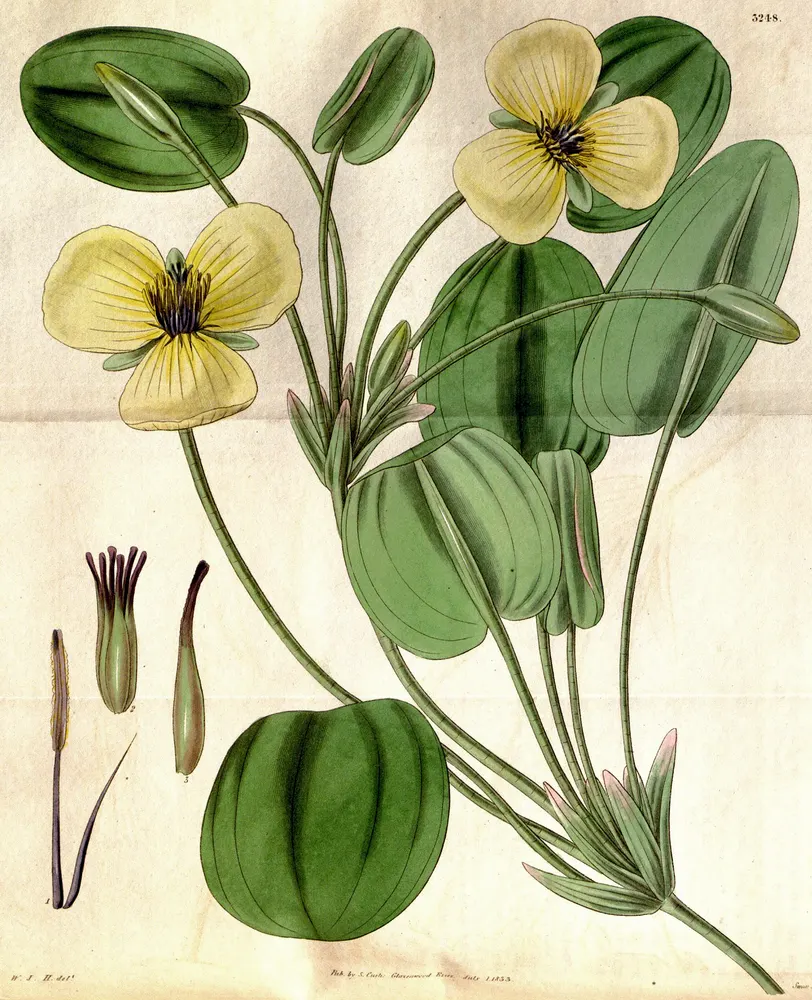
Photo: W.J. Hooker (d. 1865), Public domain (via Wikimedia Commons)
Water Poppy
Hydrocleys nymphoides
Also known as Amazon Water Poppy, Yellow Poppy, Water Poppy
Key benefits
✦Traditional uses
✦Water poppy is not a plant of the herbal medicine chest, but it carries its own quiet history as one of the most beloved floating plants in ornamental water gardening. Native to the slow rivers and marshes of Brazil, Argentina, and neighboring countries, it was carried into cultivation by water gardeners drawn to its glossy, heart-shaped leaves and its small yellow flowers that seem to glow against still water. By the late nineteenth century it had found its way into greenhouses and lily ponds across Europe and North America, and it remains a staple of tropical pond collections today. Its charm has always been ornamental rather than medicinal, valued simply for the light it brings to a water garden.
How to grow & use it
✦The full apothecary for Water Poppy
Traditional remedies and step-by-step preparations, a complete growing guide, and how to harvest, dry, and store it, all unlocked with HerbLens Unlimited.
- ✦Remedies & preparations
- ✦ Growing guide
- ✦Harvest & storage
From under $6 a month. Free plant identifications always included.
- ✦Water lettuce (Pistia stratiotes)
- ✦Pickerelweed (Pontederia cordata)
- ✦Dwarf papyrus (Cyperus involucratus)
- ✦Fringed water lily (Nymphoides spp.), for a similarly small floating bloom
- ✦Marsh marigold (Caltha palustris), for bright yellow color at a pond's edge
“For the water gardener who wants a pond scattered with small, sunlit poppies that renew themselves every morning.”
Each water poppy flower opens fresh in the morning sun and fades by the next day, but the plant keeps a steady relay of new buds coming all season, so a healthy patch always looks freshly in bloom even though no single flower lasts long.
Water poppy is grown only as an ornamental pond plant, not eaten or used medicinally, and is considered invasive in some regions.