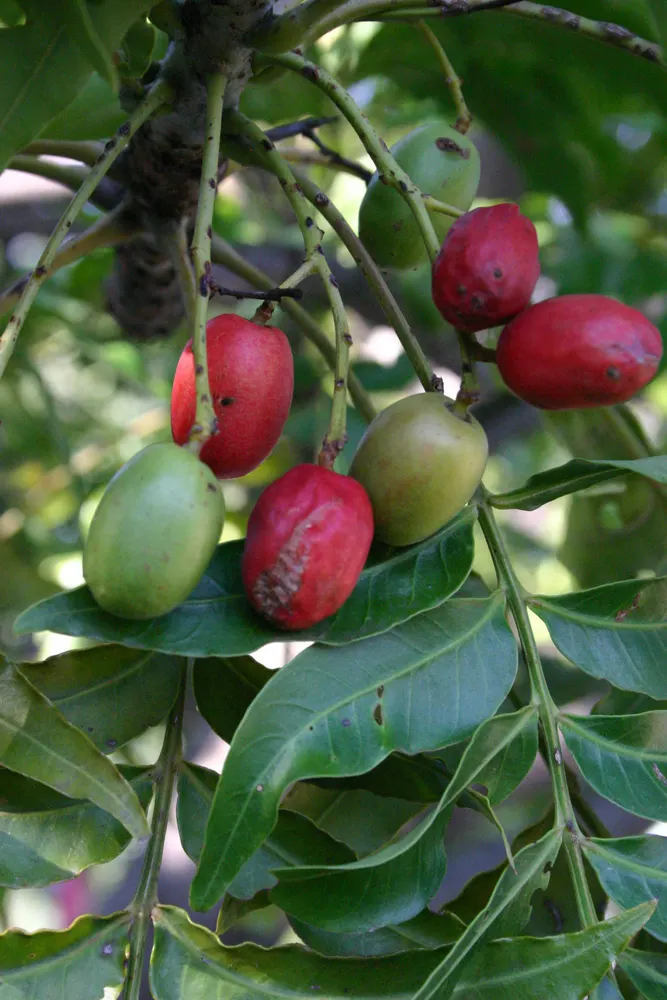
Photo: Rotational, Public domain (via Wikimedia Commons)
Wild Plum
Harpephyllum caffrum
Also known as South African Plum, Cape Plum, Umgwenya (Zulu), Bosploom (Afrikaans)
Key benefits
✦Traditional uses
✦Long before it found its way into suburban gardens, the wild plum was a forest tree that fed people, cattle, and birds alike along the coast of southern Africa. Zulu and Xhosa communities gathered the tart, plum-red fruit each summer to eat fresh or ferment into a mild traditional beer, while the bark was steeped and applied as a wash for skin complaints and taken in small amounts to settle the stomach. Colonial-era settlers adopted the fruit for jams and jellies, giving it the common name it carries today even though it is no relation to the true plums of Europe. It remains a tree woven into both kitchen tradition and folk practice across its native range.
How to grow & use it
✦The full apothecary for Wild Plum
Traditional remedies and step-by-step preparations, a complete growing guide, and how to harvest, dry, and store it, all unlocked with HerbLens Unlimited.
- ✦Remedies & preparations
- ✦ Growing guide
- ✦Harvest & storage
From under $6 a month. Free plant identifications always included.
- ✦Rooibos
- ✦Ginger
- ✦Cinnamon
- ✦Sumac (for tartness)
- ✦Hibiscus (roselle)
“For the garden that wants to feed both the table and the birds outside the window.”
Despite its name, the wild plum is not a plum at all. True plums belong to the rose family, while Harpephyllum caffrum is actually a cousin of the mango and cashew, and every winter its bright red fruit draws flocks of hungry fruit eating birds, including the striking African green pigeon.
Wild plum belongs to the same plant family as mango, cashew, and poison ivy, and its sap and bark can cause skin irritation or an allergic reaction in people sensitive to that family. Unripe fruit is quite astringent and can upset a sensitive stomach if eaten in quantity.