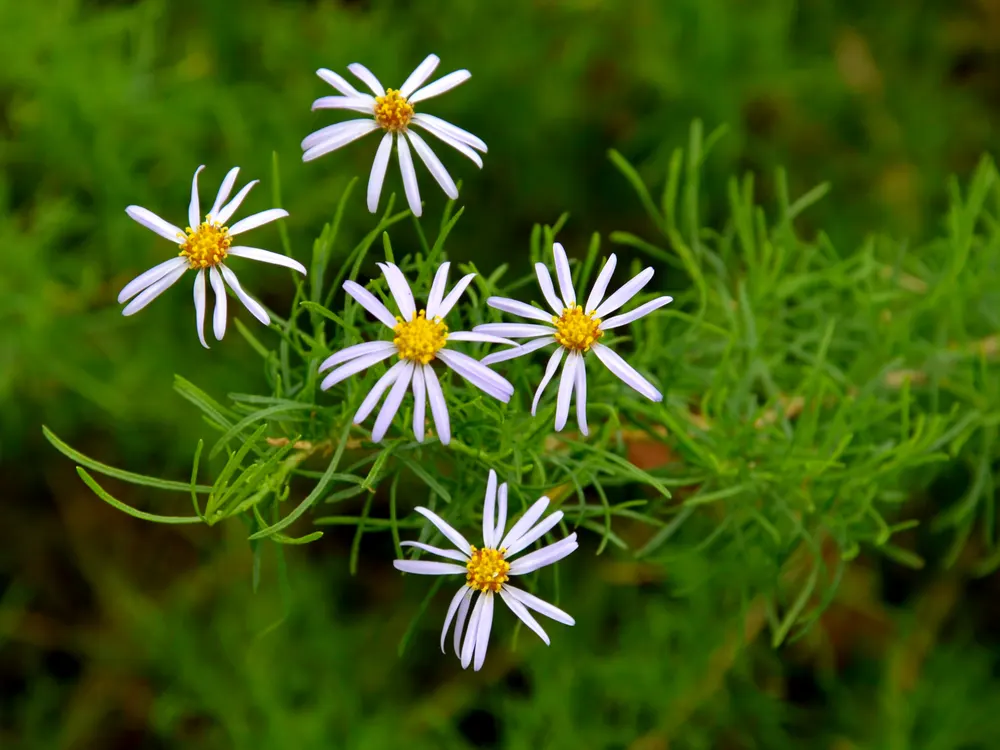
Photo: Hans Hillewaert, CC BY-SA 4.0 (via Wikimedia Commons)
Thread-leaf Felicia
Felicia filifolia
Also known as Draaibos, Fine-leaved felicia, Bergaster
Key benefits
✦Traditional uses
✦Felicia filifolia has long been woven into the rhythm of life on the Karoo veld, though its story is agricultural and ecological rather than medicinal. Farmers and rangeland ecologists have watched it for generations as a telltale sign of grazing pressure, since sheep, goats, and springbok favor its soft, thread-thin leaves and the plant tends to spread where grazing runs heavy. Beyond its native range it has traveled mainly as a tough, undemanding garden shrub, prized for the haze of small daisy flowers it throws over rocky, sun-baked ground. No meaningful tradition of internal or medicinal use has been documented for this species, so it is best appreciated as a garden and veld plant rather than an herbal remedy.
How to grow & use it
✦The full apothecary for Thread-leaf Felicia
Traditional remedies and step-by-step preparations, a complete growing guide, and how to harvest, dry, and store it, all unlocked with HerbLens Unlimited.
- ✦Remedies & preparations
- ✦ Growing guide
- ✦Harvest & storage
From under $6 a month. Free plant identifications always included.
- ✦Eriocephalus (wild rosemary)
- ✦Pelargonium species
- ✦Osteospermum (African daisy)
- ✦No established herbal substitutions, as this plant is not used medicinally
“For a tough, sun-loving shrub that turns bare, rocky ground into a drift of small blue-mauve daisies.”
The species name filifolia comes straight from Latin, filum for thread and folium for leaf, a nod to the fine, needle-like foliage that gives the whole plant its soft, hazy look even before it comes into bloom.
Thread-leaf felicia has no history of food or medicinal use. Like other daisy-family plants, contact with the foliage may irritate skin or trigger an allergic reaction in those sensitive to ragweed or related plants.