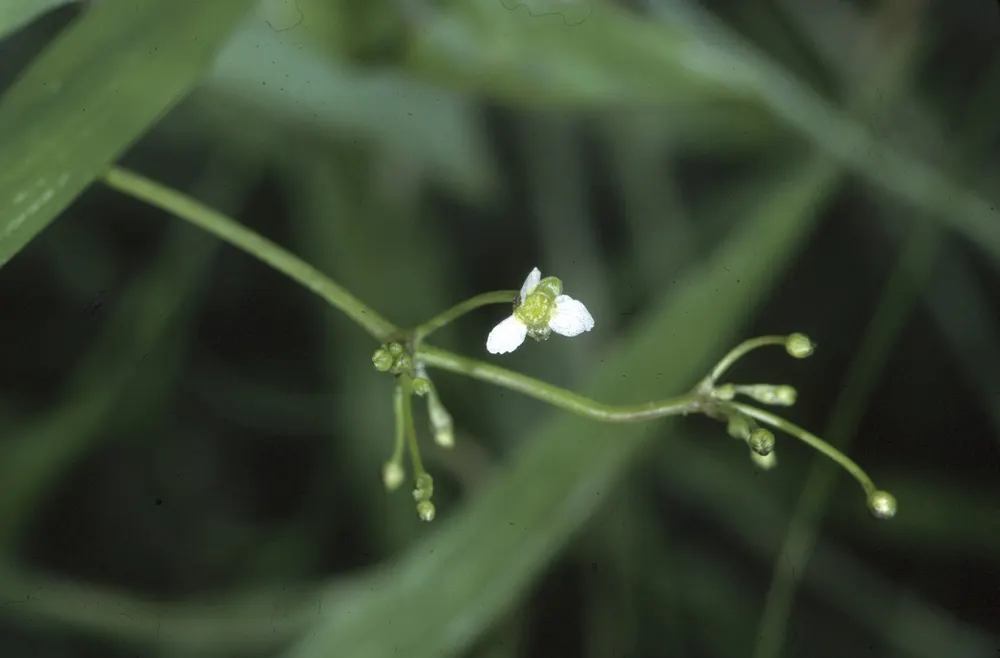
Photo: Robert H. Mohlenbrock. USDA NRCS. 1995. Northeast wetland flora: Field office guide to plant species. Northeast National Technical Center, Chester, PA. Courtesy of USDA NRCS Wetland Science Institute., Public domain (via Wikimedia Commons)
American Water Plantain
Alisma subcordatum
Also known as Water Plantain, Mud Plantain, Southern Water Plantain
Key benefits
✦Traditional uses
✦American water plantain grows quietly at the edges of ponds and slow streams, its heart-shaped leaves and airy sprays of tiny white flowers easy to overlook. Some Native American communities dug the starchy corms and cooked them as a food source, since the raw root carries an acrid bite that heat and drying gently tame. It belongs to the same small family as Alisma orientale, known in traditional Chinese medicine as Ze Xie, a root long simmered into decoctions and valued for supporting healthy fluid balance, a reputation that has led some modern herbalists to look to the American species in a similar light, though its own record of use is thinner and more folk than formal. Today it is better known to naturalists and pond gardeners than to herbalists, prized for the movement it brings to a marshy border and the frogs and dragonflies it invites in.
Growing guide
✦Fresh to dried
✦Traditional preparations
✦Dried Root Decoction
Following the long tradition established for its Asian relative Ze Xie, the dried corm has occasionally been simmered into a mild decoction thought to support healthy fluid balance.
How it's made. Traditionally, a decoction is made by simmering 1 teaspoon of the dried, sliced corm in 1 cup of water for 10 to 15 minutes, then straining and taking occasionally.
- ✦Dandelion leaf
- ✦Nettle
- ✦Corn silk
- ✦Alisma orientale (Ze Xie)
- ✦Dandelion root
“For the quiet muddy margins where marsh meets meadow.”
Despite its name, water plantain is not related to the broadleaf plantains (Plantago) that carpet lawns and trail sides. Early botanists simply borrowed the name for the similar shape of its leaves, one growing in mud and marshes, the other underfoot almost everywhere else.
The raw corm contains acrid juice that irritates the mouth, throat, and skin, so it should only be used cooked or dried, never raw. It's traditionally considered a diuretic, so it's best avoided in pregnancy and used cautiously if you take diuretic medication or have kidney concerns.