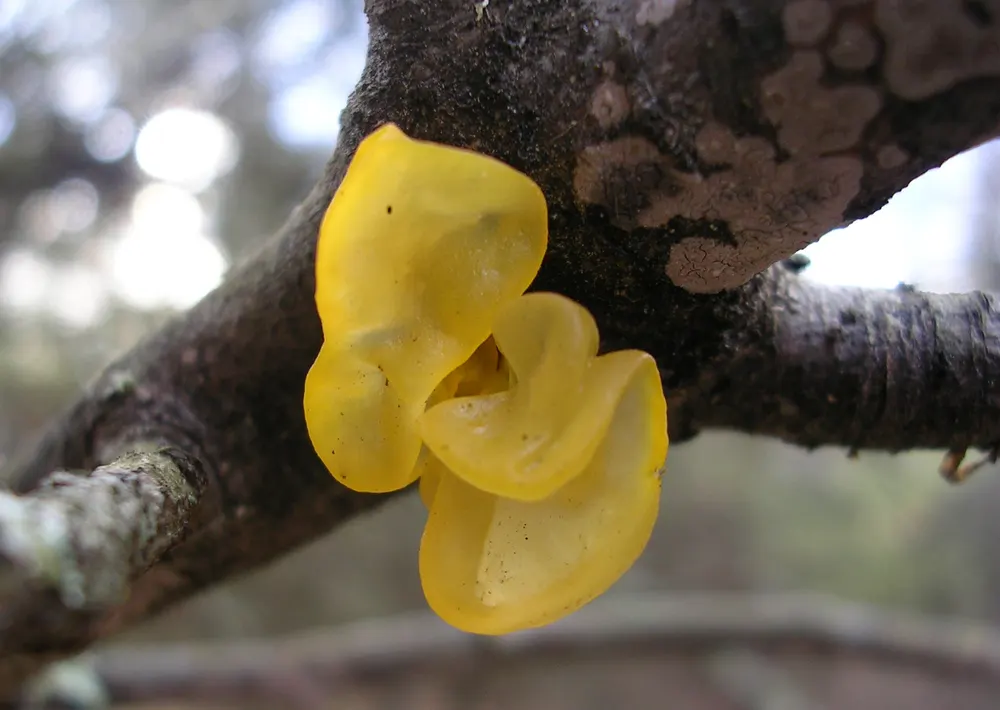
Photo: J. Carmichael, Public domain (via Wikimedia Commons)
Witch's Butter
Tremella mesenterica
Also known as Witch's Butter, Yellow Brain, Golden Jelly Fungus, Yellow Trembler, Brain Fungus
Key benefits
✦Traditional uses
✦Witch's butter earned its name from old European and Appalachian folklore, which held that if the golden jelly appeared on your gate, fence, or door, a witch had laid a curse on your house, and country folk would prick it with pins or burn it to break the spell. In parts of China, golden jelly fungi have long been gathered alongside their whiter cousin and simmered into gentle, nourishing soups, valued more for their soft, translucent texture than for flavor, which is famously mild to nearly tasteless. Foragers have also passed down a simpler, quieter tradition of just admiring it: a startling bead of gold on a gray winter branch, appearing almost overnight after rain and vanishing again as the wood dries. It was sometimes rubbed fresh onto small cuts and chapped skin in old country practice, valued for its cool, slippery, cushioning feel rather than any dramatic cure.
How to grow & use it
✦The full apothecary for Witch's Butter
Traditional remedies and step-by-step preparations, a complete growing guide, and how to harvest, dry, and store it, all unlocked with HerbLens Unlimited.
- ✦Remedies & preparations
- ✦ Growing guide
- ✦Harvest & storage
From under $6 a month. Free plant identifications always included.
- ✦Goji Berry
- ✦Red Date (Jujube)
- ✦Fresh Ginger
- ✦Tremella fuciformis (Snow Fungus)
- ✦Wood Ear (Auricularia)
“When a bead of gold trembles on a rain-soaked branch, and the woods ask you to slow down and look closer.”
In old English and Appalachian folk belief, witch's butter appearing on a gate or doorpost was taken as proof a witch had cursed the household, and the traditional remedy was to pierce the jelly with a pin or burn it to break the hex.
Witch's butter is generally regarded as edible and non-toxic, though correct identification is needed to distinguish it from other gelatinous wood fungi.