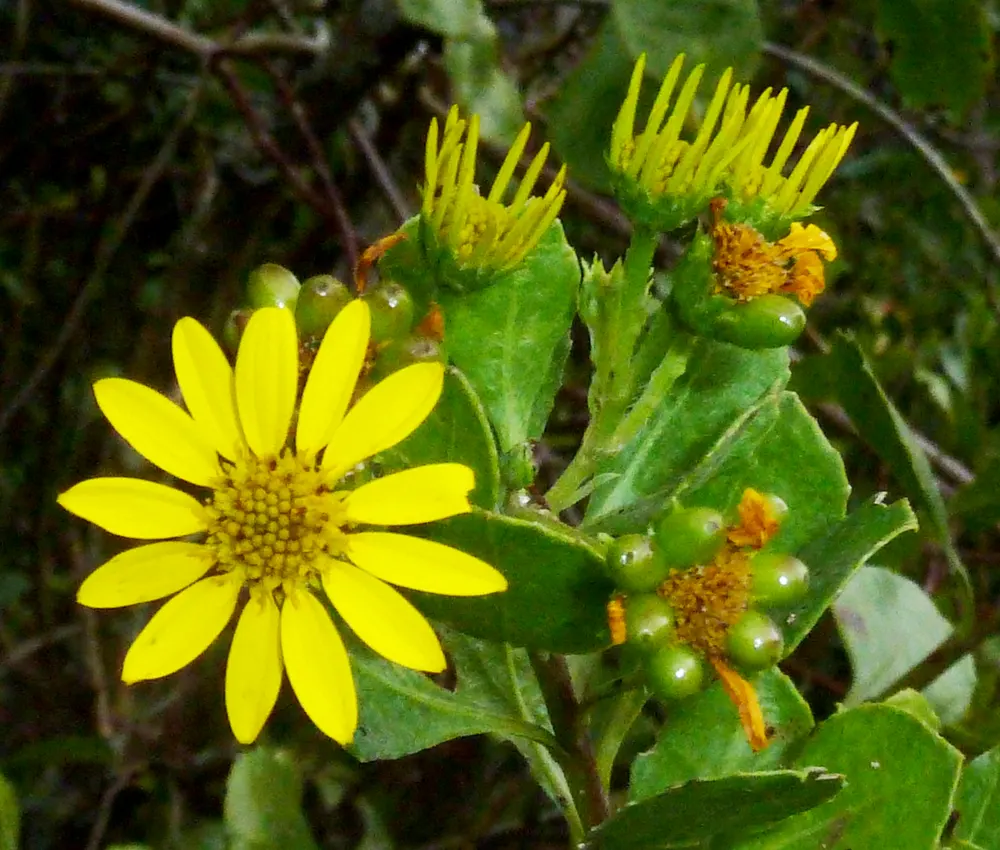
Photo: JMK, CC BY-SA 3.0 (via Wikimedia Commons)
Boneseed
Chrysanthemoides monilifera
Also known as Bitou Bush, Bietou, Higenbossie, South African Boneseed, Cape Ivory
Key benefits
✦Traditional uses
✦Boneseed's story is really a story of place. Along the fynbos-fringed coasts of South Africa, where it is called bietou in Afrikaans, this tough little shrub has long been one of the first plants to take hold on bare, wind-scoured dune sand, knitting the ground together with its roots while its cheerful yellow flowers fed local bees and its dark berries fed birds. It does not carry a documented tradition as a medicinal or culinary herb the way plants like echinacea or chamomile do. Instead, its cultural legacy is ecological and, more recently, cautionary. Carried to Australia in the early 1900s, likely in ship's ballast and later spread further as a mine-site and garden planting valued for the same dune-holding toughness that made it useful at home, it escaped cultivation and became one of that continent's most notorious coastal weeds, a reminder of how a plant's meaning can shift entirely depending on where it takes root.
How to grow & use it
✦The full apothecary for Boneseed
Traditional remedies and step-by-step preparations, a complete growing guide, and how to harvest, dry, and store it, all unlocked with HerbLens Unlimited.
- ✦Remedies & preparations
- ✦ Growing guide
- ✦Harvest & storage
From under $6 a month. Free plant identifications always included.
“A hardy dune-holder from the South African coast, better admired where it belongs than invited into a garden elsewhere.”
Boneseed gets its evocative name from the fruit itself. Beneath the black, fleshy skin of each berry sits a single hard, pale, bone-colored seed, and it was this small bony kernel, more than the flower or the leaf, that gave the plant its common name.
Boneseed has no established tradition of safe eating and, like many daisy-family plants, can cause skin irritation in sensitive people on contact. It is also a serious invasive weed in places like Australia, so it shouldn't be planted or encouraged to spread.