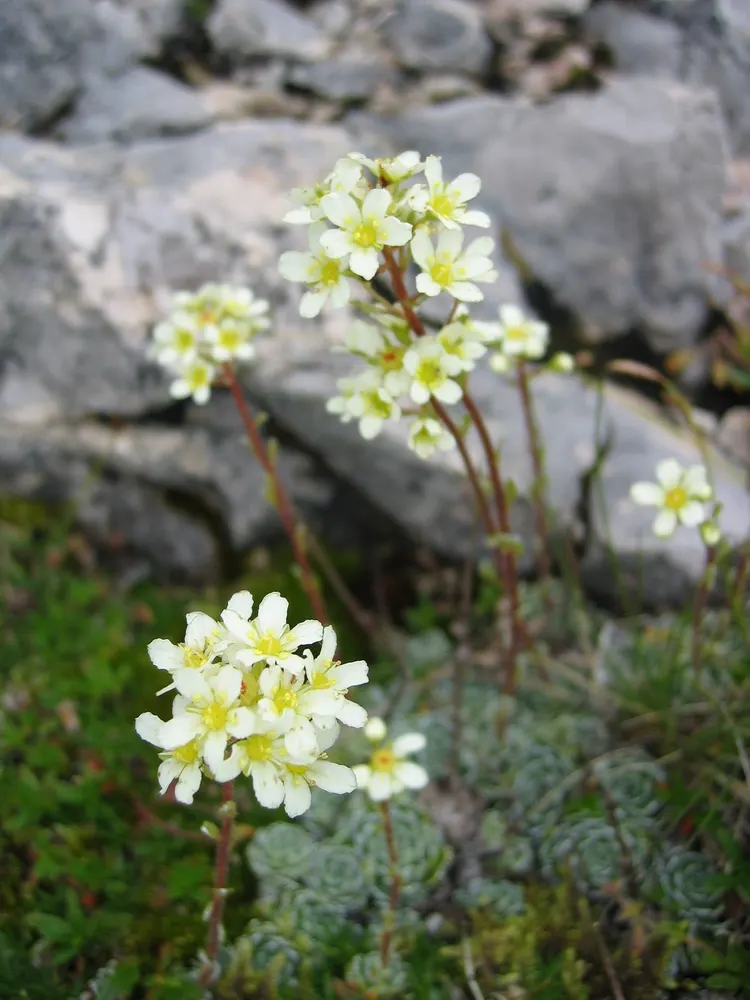
Photo: CC BY-SA 3.0 (via Wikimedia Commons)
White Mountain Saxifrage
Saxifraga paniculata
Also known as Livelong Saxifrage, Encrusted Saxifrage, Aizoon Saxifrage
Key benefits
✦Traditional uses
✦White mountain saxifrage is best known not as a remedy but as a survivor, a small rosette that finds a foothold in bare rock where almost nothing else will grow, then edges its leaves with tiny beads of lime drawn up from the stone itself. Its genus name comes from the Latin saxum, meaning rock, and frangere, to break, a nod either to how the roots seem to split stone or to an old medieval belief, applied broadly across the saxifrage family, that a plant capable of cracking rock could likewise dissolve stones forming inside the body. That doctrine-of-signatures idea attached itself more firmly to a few cousin species in the genus than to this one, and White mountain saxifrage itself was never widely taken up as a folk remedy. Instead it earned its keep for centuries in cottage rockeries and alpine troughs, admired simply for holding its ground and its color through hard winters.
How to grow & use it
✦The full apothecary for White Mountain Saxifrage
Traditional remedies and step-by-step preparations, a complete growing guide, and how to harvest, dry, and store it, all unlocked with HerbLens Unlimited.
- ✦Remedies & preparations
- ✦ Growing guide
- ✦Harvest & storage
From under $6 a month. Free plant identifications always included.
- ✦Sempervivum (hens and chicks)
- ✦Creeping thyme
- ✦Alpine sedum
- ✦Saxifraga granulata (meadow saxifrage) for a similarly hardy rock garden alternative
“For the gardener who wants a living tapestry clinging to bare stone, blooming stubbornly where almost nothing else will take root.”
The lacy white crust along this saxifrage's leaf edges isn't frost or dust, it is pure lime, secreted by tiny pores called hydathodes that pull mineral-rich water up from the limestone the plant grows on and leave the excess behind as a chalky trim.
White mountain saxifrage isn't known to be toxic, but it also has no established history of food or medicinal use, so there's no safe dose to offer. Don't eat wild-collected plants without expert identification, since similar alpine rosettes are easy to mix up.