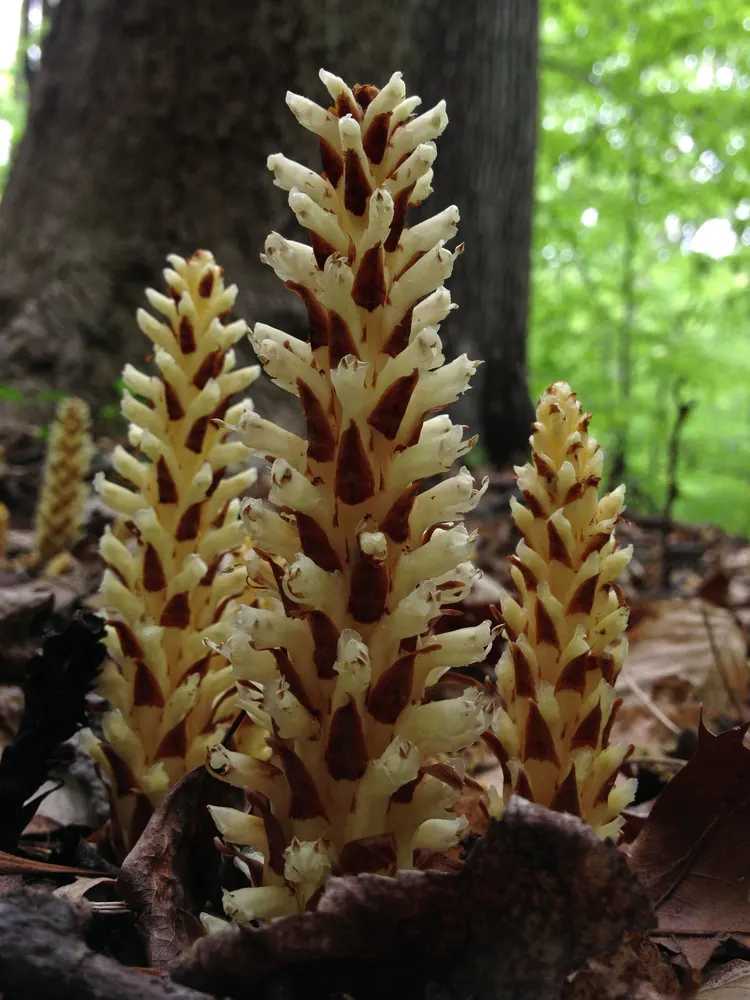
Photo: Fritzflohrreynolds, CC BY-SA 3.0 (via Wikimedia Commons)
Squawroot (American Cancer-Root)
Conopholis americana
Also known as Squawroot, American cancer-root, Bear corn, Clapwort, Squaw root
Key benefits
✦Traditional uses
✦Squawroot is one of the odder residents of the eastern hardwood forest, a plant with no leaves and no green in it at all, living entirely off the roots of oak trees. Some Native American communities gathered the young stalks and used them in preparations connected to women's health and postpartum recovery, which is where the old common name comes from, and applied crushed or steeped material to skin as a wash for sores and bruises. The name "cancer-root" refers to the plant's knobby, tumor-like appearance pushing up through the soil, not to any documented cancer treatment, and it's worth clearing up that confusion whenever the plant comes up. Because so little modern research exists on it, squawroot has remained a forager's curiosity more than a working household remedy.
How to grow & use it
✦The full apothecary for Squawroot (American Cancer-Root)
Traditional remedies and step-by-step preparations, a complete growing guide, and how to harvest, dry, and store it, all unlocked with HerbLens Unlimited.
- ✦Remedies & preparations
- ✦ Growing guide
- ✦Harvest & storage
From under $6 a month. Free plant identifications always included.
- ✦Yarrow
- ✦Witch hazel
- ✦Black cohosh (Actaea racemosa)
- ✦Wild yam (Dioscorea villosa)
“For the walk where you nearly step on it, that pale, knobby cone rising leafless from the leaf litter, and you realize the whole forest floor has stories you've never noticed.”
Squawroot has no chlorophyll whatsoever. It taps directly into an oak tree's root system for all its food and water, which is why the whole plant looks like a pale, waxy little corn cob or pinecone pushing straight up out of the forest floor instead of a normal green stem and leaves.
Not well studied today, with little reliable information on safe dosing or interactions; avoid during pregnancy and breastfeeding given its traditional link to uterine effects. Not a plant to forage and self-treat with.