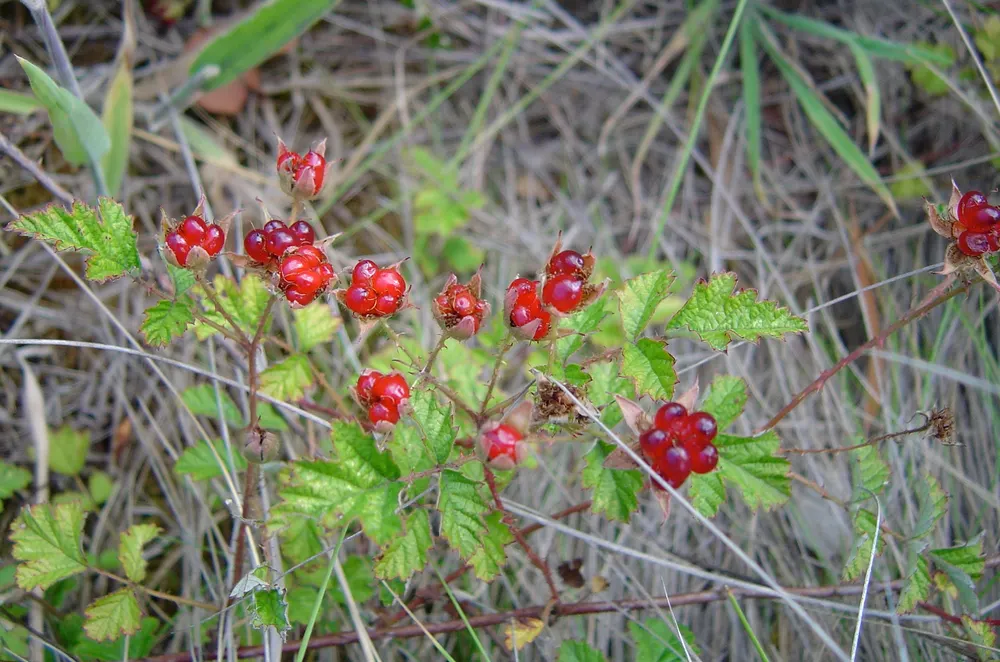
Photo: Nadiatalent, Public domain (via Wikimedia Commons)
Native Raspberry
Rubus parvifolius
Also known as Australian Raspberry, Japanese Raspberry, Suzume-ichigo, Small-leaf Bramble
Key benefits
✦Traditional uses
✦Long before it had a botanical name, this scrambling little bramble was quietly gathered along forest margins in Australia, China, Japan, and Korea, its jewel-red fruit eaten fresh off the cane and its leaves dried for tea. In Traditional Chinese Medicine, related parts of the plant were valued as a mild tonic, and across its range the leaves were steeped much as other raspberry leaves have been, as a gentle, astringent infusion reached for around the cycles of a woman's life. It has never carried the fame of its European cousin, but where it grows wild it has long been a familiar, trusted little shrub, equal parts food and medicine cabinet.
How to grow & use it
✦The full apothecary for Native Raspberry
Traditional remedies and step-by-step preparations, a complete growing guide, and how to harvest, dry, and store it, all unlocked with HerbLens Unlimited.
- ✦Remedies & preparations
- ✦ Growing guide
- ✦Harvest & storage
From under $6 a month. Free plant identifications always included.
- ✦Red Raspberry Leaf
- ✦Nettle
- ✦Rose Hip
- ✦Red Raspberry Leaf (Rubus idaeus)
- ✦Blackberry Leaf
“For the quiet bramble at the forest's edge, offering both a handful of sweetness and a gentle cup of tea.”
In Japan the plant is called suzume-ichigo, or sparrow's strawberry, because its berries are just the right size for a small bird to carry off whole.
Native raspberry fruit is fine to eat, but the leaf tea has a mild uterine-stimulating effect similar to raspberry leaf, so it's traditionally avoided in early pregnancy.